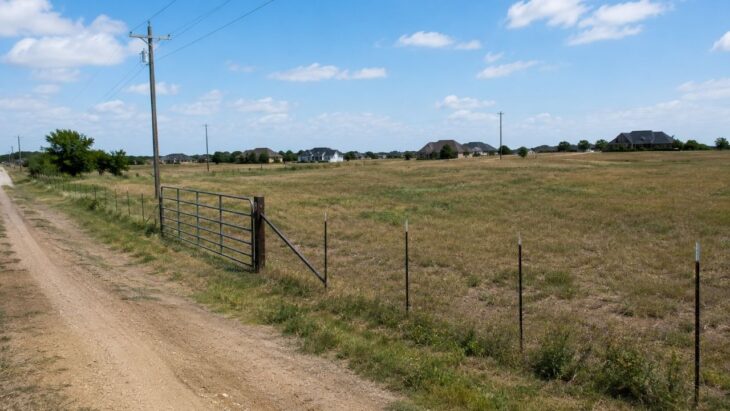
Something odd is happening in the American dirt market. Prices per acre keep setting records while the volume of land actually changing hands shrinks.
The Texas Real Estate Research Center at Texas A&M put the statewide rural average at $5,218 per acre in the second quarter of 2026, a 3.27 percent gain over the previous year. Total acres sold over the same period fell 12.57 percent.
Two numbers moving in opposite directions usually mean one thing: sellers are holding firm and buyers have gone quiet. For anyone weighing land investing in 2026, the silence is the opportunity. Borrowing costs have thinned the crowd without breaking values, leaving patient buyers with fewer rivals than at any point since the pandemic land rush.
What a Mid-6% Market Actually Looks Like
Fannie Mae’s updated forecast for the 30-year fixed mortgage rate:
Q1 2026 -> 6.2%
Q2 2026 -> 6.1%
Q3 2026 -> 6.0%
Q4 2026 -> 5.9%Q1 2027 -> 5.9%
Q2 2027 -> 5.9%
Q3 2027 -> 5.9%
Q4 2027 -> 5.9% pic.twitter.com/wXR35ncWFm— Lance Lambert (@NewsLambert) November 25, 2025
Rates have refused to cooperate with the forecasts written for the year. Fannie Mae’s June housing forecast puts the 30-year fixed rate near 6.4 percent for the remainder of 2026, while the Mortgage Bankers Association pencils in 6.5 percent for the third and fourth quarters.
A Reuters poll of property specialists in June reached a blunter conclusion: the mid-6 percent range shows no sign of falling meaningfully any time soon.
J.P. Morgan Global Research expects home prices to stay flat in 2026 and rise about 3 percent in 2027, with existing-home sales down 4.2 percent across the first half of the year. Median home prices hit an all-time high of $440,600 in July after 36 straight months of increases, a figure that fits the wider pattern in US real estate statistics showing affordability doing the rationing.
Land sits on a different track. Vacant parcels rarely trade on monthly payment math, because most buyers cannot get a 30-year amortization on them anyway. Land loans in 2026 typically run between 6.5 and 10 percent, roughly one to three points above a comparable home mortgage, with far heavier equity requirements.
| Loan type | Typical 2026 rate | Down payment | Term | Credit floor |
|---|---|---|---|---|
| 30-year home mortgage | 6.4% to 6.8% | 3% to 20% | 30 years | 620+ |
| Improved lot (utilities, road) | 7.5% to 9% | 20% to 30% | 10 to 20 years | 660 to 680 |
| Raw land, no utilities | 8.5% to 10%+ | 30% to 50% | 5 to 15 years | 700+ |
Read the bottom row carefully, because it explains the whole market. A lender demanding half the purchase price in cash has effectively removed leverage from the equation, and with leverage goes most of the retail competition.
Land investing then becomes a contest among cash buyers, 1031 exchange money, and sellers willing to carry paper themselves.
Records on Paper, Quiet at The Closing Table
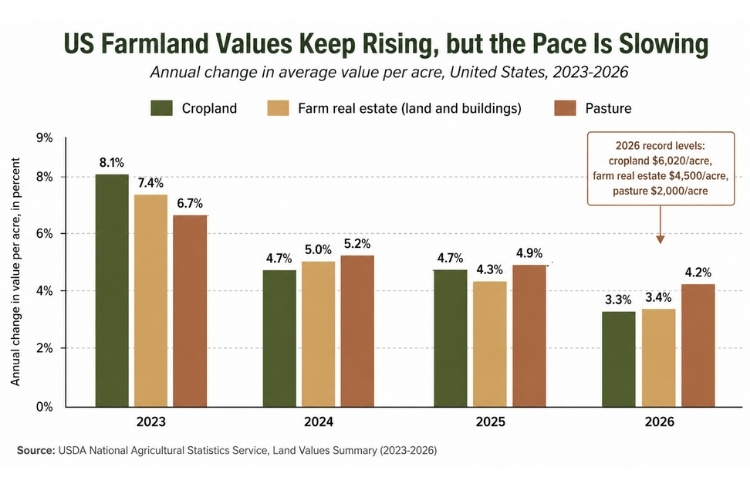
The USDA released its annual Land Values Summary on July 31, 2026, built from a survey of roughly 30,000 farm operations. Average cropland crossed $6,000 an acre for the first time on record, landing at $6,020, up 3.3 percent. Pastureland reached $2,000, up 4.2 percent. Farm real estate as a whole, land plus buildings, averaged $4,500 per acre.
The growth rate tells the more useful story. That 3.3 percent gain was the smallest annual increase since the upswing began in 2021, according to the American Farm Bureau Federation, even though values sit 48 percent above 2020 levels.
So the asset class has had its run, and what changed in 2026 is the pace.
In Texas, brokers describe a standoff with sellers still anchored to peak 2022 and 2023 pricing, producing longer days on market for anything lacking prime location. Inventory sits. Offers get answered.
One regional detail is worth watching. West Texas prices jumped to a record near $3,008 per acre in the second quarter, partly on speculation over parcels with data center potential. Land investing near a substation with spare capacity has become a different business from land investing forty miles further out, even when the soil is identical.
The Builders Moved First
Public homebuilders spent the last several years moving land off their own balance sheets. Lennar’s creation of Millrose Properties transferred $5.5 billion in land assets and $1 billion in cash in a single transaction.
By 2026 the vocabulary changed again. Industry coverage now describes the priority as “land right” rather than land light: controlling the right locations and lot counts on the right schedule. Bulk acquisitions have given way to phased takedown agreements, while new lot supply in constrained markets remains 18 to 24 months out because entitlement pipelines are clogged.
The shift is easier to follow in visual form, and the walkthrough below traces how the asset-light model developed and why builders adopted it.
The gap between the two is where individual land investing still has room to operate, because the parcel needing a rezoning, a survey, and a road easement is precisely the parcel a land bank does not want on a takedown schedule.
Where Returns Come from When Appreciation Cools
View this post on Instagram
A residential land advisory put it bluntly in a 2026 note: passive land appreciation is over as a strategy. Waiting for the market to lift a parcel worked beautifully from 2020 through 2022, and it works poorly against property taxes, no rent, and a Federal Reserve holding its target range at 3.5 to 3.75 percent.
Value Comes from Improvement
Money is now made by changing what a parcel legally is. A perc test confirming septic feasibility, a recorded access easement replacing a handshake two-track, a split of 40 acres into four ten-acre parcels, a rezoning from agricultural to residential: each step converts a speculative holding into something a bank will lend against.
Most of those steps require a drawing the county will accept. A scaled site plan showing setbacks, driveway location, and drainage is standard with permit applications, and professionals from Get a Site Plan or a local civil engineer can produce one from an existing survey.
Seller Financing Cuts Both Ways
Owner financing has quietly become the workhorse of small-scale land investing. On the buy side it sidesteps the heavy cash requirement that stops most bank-financed purchases of raw ground.
On the sell side it turns the investor into the lender, and note yields in the 9 to 10 percent range are attainable precisely because conventional credit is expensive and slow for vacant land. As passive income streams go, a seasoned land note is among the plainer ones: fixed payments, real collateral, and a yield that widens when bank credit tightens.
The Part of The Story that Ends Badly

One historical figure is worth sitting with. In inflation-adjusted terms, U.S. farm real estate peaked at roughly $2,927 per acre in 1981, measured in 2024 dollars, right before the agricultural credit crisis of the 1980s wiped out a generation of leveraged farmers. Real values took decades to recover, and the farmers who went under were sunk by debt service while the soil kept growing corn.
The live risks in 2026:
- No income to carry the cost. A vacant parcel generates nothing while taxes and insurance accrue. A cash lease, timber, hunting rights, or a cabin run on the same economics behind Airbnb hosting can offset part of the burden.
- Genuine illiquidity. Rural tracts without road frontage can sit for a year or longer. Land also gets a fraction of the portal exposure homes do, and Zillow alone accounts for close to a third of real estate website traffic.
- Financing risk transfers to your buyer. If a purchaser cannot get a land loan on reasonable terms, your exit narrows to cash or your own willingness to carry a note.
- Concentrated speculative demand. Data center and renewable energy interest is real, geographically narrow, and capable of reversing when a utility interconnection queue closes.
A Short Checklist Before the First Parcel
Land investing in a mid-6 percent market is a slow, unglamorous business that rewards preparation over timing. The backdrop is unusually legible: rates parked in a narrow band, home prices flat nationally, farmland values at records with growth slowing, and volume down enough that sellers answer the phone. Which is the point. The contrarian case for land investing has never depended on a crash, only on a crowd looking elsewhere while good parcels sit unsold in a market everyone has decided is boring. Land investing in a mid-6% rate market: 2026 farmland data, land loan terms, builder strategy shifts, and where returns actually come from.
Where It Leaves You