
A manager with five employees might have time to meet everyone individually, review their work, and help when problems arise. Give that same manager 20 employees, and the working day starts to look very different. Meetings take longer, performance reviews pile up, and people who need help may have to wait.
So, how many employees can one manager realistically supervise?
For many office-based teams, five to ten direct reports is a reasonable starting point. Managers responsible for specialized work may handle fewer, while supervisors overseeing routine, well-organized tasks may manage 15 or more. The actual limit depends on the employees, their responsibilities, and how much support the manager receives.
Research also shows that the number of people reporting to managers has been increasing. Yet having more employees under one supervisor does not automatically mean those employees are receiving enough guidance.
How Many Employees Should Report to One Manager?
Gallup reported that American managers had an average of 12.1 direct reports in 2025, up from 10.9 in 2024. However, the median was only six, meaning the typical team was considerably smaller than the average suggests.
According to Gallup’s research, 66% of managers supervised fewer than ten employees, while 13% were responsible for teams of at least 25 people.
The numbers show how widely management responsibilities vary across workplaces. A department head directing experienced specialists has a very different job from a retail supervisor coordinating employees who follow established procedures.
McKinsey has also examined the number of employees managers can effectively supervise. Its research identifies several management roles, each with a suggested range of direct reports based on the complexity of the work.
| Type of Manager | Typical Direct Reports | Example |
| Manager who also performs specialist work | 3–5 | Senior developer leading a small technical team |
| Manager who coaches employees regularly | 6–7 | Marketing or analytics team manager |
| Manager overseeing established processes | 8–10 | Accounting department manager |
| Manager coordinating standardized work | 11–15 | Supervisor of a routine administrative team |
| Manager supervising highly repetitive work | 15 or more | Call center operations manager |
Source: McKinsey’s management structure research. The ranges are management guidelines, not mandatory staffing limits.
A company should not automatically assign ten employees to every manager just because that number appears reasonable on paper. The work itself determines how much supervision is necessary.
What Determines How Many Employees a Manager Can Handle?

How Much Guidance Employees Need
Experienced employees who know their responsibilities can usually work with less supervision. They make routine decisions independently and contact their manager when an issue falls outside their authority.
New employees need more attention. Someone learning a new job may need help several times throughout the day, especially when the work involves complicated procedures, customer complaints, or expensive mistakes.
Imagine a manager responsible for eight experienced accountants. Most already know the reporting procedures and deadlines. Now imagine another manager supervising eight new employees who are learning those procedures for the first time.
The teams are the same size, but the second manager will spend far more time explaining tasks, correcting errors, and answering questions.
Developing strong leadership skills also helps managers delegate responsibilities and support employees without constantly supervising their work.
How Much Work the Manager Must Do Personally
Some managers spend most of their working hours supervising others. They assign responsibilities, monitor results, conduct meetings, and resolve problems.
Others must complete their own projects alongside those responsibilities.
A software developer who supervises four colleagues might still spend several hours writing code every day. Adding another six employees could leave little time for either development work or individual support.
Smaller businesses face another challenge because owners and managers frequently handle recruitment, employee documentation, and workplace issues themselves. When those duties begin taking time away from supervising employees, external fractional hr support can help handle personnel administration and employee relations without assigning every responsibility to the same manager.
Separating administrative duties from daily supervision gives managers more time to concentrate on their employees and the work they are responsible for delivering.
How Complicated the Work Is
Managing ten employees who perform predictable daily tasks is not the same as managing ten people working on separate projects.
A warehouse supervisor might oversee employees who follow established picking, packing, and shipping procedures. A product development manager may lead engineers, designers, and researchers whose assignments involve independent decisions and unexpected challenges.
The second manager needs more time to review progress, coordinate people, and resolve technical questions.
How Much Authority Employees Have
Teams function more independently when employees have permission to make routine decisions.
If every minor purchase, customer request, or scheduling adjustment requires management approval, even a small team can overwhelm its supervisor.
Managers can reduce unnecessary interruptions by establishing clear responsibilities and explaining which decisions employees can make without asking permission.
How Much Time Does Managing a Team Actually Take?

Consider a manager supervising ten employees who schedules a 30-minute individual meeting with each person every week.
Those meetings alone require five hours.
Add preparation, follow-up conversations, a weekly team meeting, and performance documentation. The manager could easily spend much of the working week on communication before addressing urgent problems or their own assignments.
Now increase the team to 20 employees.
Individual meetings would consume ten hours each week, assuming everyone still receives the same attention. If the manager also attends leadership meetings, handles recruitment, and completes specialist work, keeping up becomes increasingly difficult.
The following example shows how quickly recurring meetings accumulate.
| Number of Employees | Weekly One-on-One Meetings | Time Required |
| 5 | 5 meetings | 2.5 hours |
| 10 | 10 meetings | 5 hours |
| 15 | 15 meetings | 7.5 hours |
| 20 | 20 meetings | 10 hours |
| 25 | 25 meetings | 12.5 hours |
Illustrative calculation based on one 30-minute meeting per employee per week. Preparation and other management duties are excluded.
Not every team needs weekly individual meetings. Some employees may benefit from shorter check-ins or less frequent conversations. However, removing meetings simply to make a larger team manageable can leave employees without enough support.
What Happens When a Manager Has Too Many Employees?

Problems rarely appear immediately after another employee joins the team. Work continues, deadlines are met, and the manager may initially believe the larger workload is manageable.
Over time, employees may start waiting longer for decisions. Performance reviews get postponed, and routine questions go unanswered because urgent problems receive priority.
- Employees wait too long for feedback. Work is completed without timely guidance, making mistakes harder to correct.
- The manager spends the day responding to interruptions. There is little uninterrupted time for planning, coaching, or completing important assignments.
- Performance reviews become rushed. Conversations focus on completing paperwork rather than helping employees improve.
- Problems reach management too late. Employees delay raising concerns because their supervisor is constantly occupied.
- New hires receive inconsistent training. Experienced employees become responsible for explaining procedures without a clear training plan.
- Employees are unsure who makes decisions. Work slows because responsibilities and approval authority are unclear.
One of the clearest warning signs is a manager who spends nearly every working day resolving immediate problems but rarely has time to prevent the same problems from returning.
Employee performance may suffer even when the manager is working longer hours. Adding more effort cannot always compensate for a team structure that leaves too little time for supervision.
Persistent workload pressure can also lead to employee burnout, especially when teams face unrealistic deadlines and insufficient support.
Can One Manager Supervise 20 or More Employees?
Yes, particularly when employees perform standardized work, receive clear instructions, and have systems that support daily operations.
A call center manager might supervise more than 20 employees because the team follows established procedures, performance information is readily available, and specialized staff can handle training or technical issues.
A manager supervising 20 consultants working on separate client projects faces a different challenge. Each employee may need individual coaching, project reviews, and help resolving client-specific problems.
McKinsey’s research allows for teams of 15 or more under managers whose primary responsibility is coordinating highly standardized work. Its suggested range falls to three to five employees when the manager also performs substantial specialist work.
A large team can function successfully, but only if the work and organizational structure allow the supervisor to give employees the attention they need.

When Should a Company Hire Another Manager?
Hiring another manager makes sense when the existing supervisor can no longer give employees sufficient direction without neglecting other responsibilities.
As organizations expand, their business growth strategies should account for management capacity alongside hiring and operational demands.
Headcount provides one signal, but a business should also examine how decisions get made and how long employees wait for guidance.
Consider a marketing agency with one manager overseeing 14 employees. If half the employees work independently on established client relationships, the arrangement may function well.
But if the agency takes on several new clients, recruits inexperienced staff, and gives the manager responsibility for new business development, the workload changes even if employee numbers remain the same.
- Could experienced employees take ownership of specific projects?
- Are routine approvals unnecessarily reaching the manager?
- Would a dedicated trainer reduce the time spent onboarding new staff?
- Could administrative support free the manager to focus on supervision?
- Does the team need a second person with authority to make decisions?
When responsibility for employees is genuinely too concentrated, dividing the team between two supervisors may improve access to feedback and decision-making.
However, adding a second manager without defining responsibilities can create confusion. Employees need to know who supervises their work and who has the authority to approve decisions.
How to Work Out the Right Team Size for Your Business
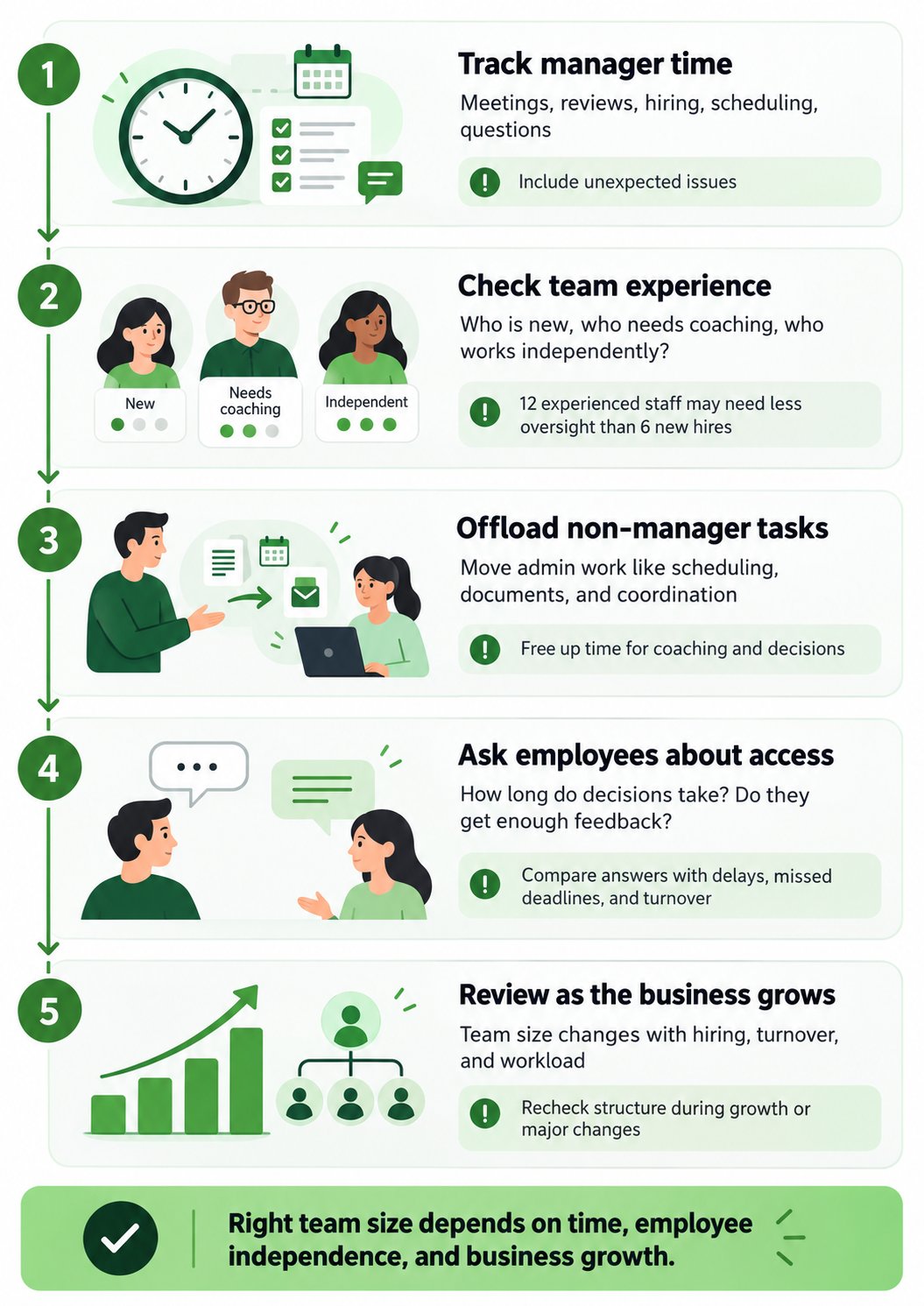
Start with the work your manager actually performs during a normal week, not with an ideal employee-to-manager ratio taken from another company.
1. Calculate the Time Spent on Direct Supervision
List individual meetings, team meetings, recruitment interviews, performance reviews, scheduling, and employee questions. Record how many hours those responsibilities consume.
Include the time required for unexpected situations. A manager who has no available time for urgent problems is already working with very little flexibility.
2. Review Employee Experience and Independence
Count how many employees are new, how many regularly need coaching, and how many can handle their responsibilities independently.
A team of twelve experienced employees may need less direct guidance than a team of six new starters.
3. Identify Responsibilities That Do Not Require a Manager
Routine scheduling, document collection, meeting coordination, and certain administrative tasks do not always need to be completed by the person supervising the team.
Redistributing those duties can create more time for performance reviews, coaching, and solving operational problems.
4. Ask Employees About Access to Their Manager
Employees can identify issues that workload reports do not reveal.
Ask how long they normally wait for decisions, if they receive enough feedback, and if unresolved problems prevent them from completing assignments.
Compare their answers with actual delays, missed deadlines, turnover, and the time managers spend handling recurring issues.
5. Review the Team Structure as the Business Grows
The number of employees a manager can supervise is not fixed for the entire life of a business.
A supervisor might manage twelve experienced employees successfully today but struggle with the same number next year if several experienced workers leave and their replacements need extensive training.
Reviewing team responsibilities during hiring, restructuring, or major changes in workload helps prevent management responsibilities from expanding without enough support.
Understanding how leadership structure changes as a business matures can also help companies decide when additional management layers become necessary.
Frequently Asked Questions
What Is a Realistic Number of Employees for One Manager?
If a manager leads a team doing complex work and contributes heavily to that work, three to seven direct reports may be more manageable. For experienced office teams with established procedures, eight to ten employees can be a reasonable starting point. Supervisors whose main job is coordinating standardized tasks may successfully oversee fifteen or more.
Gallup’s 2025 data shows an average of 12.1 direct reports, but a median of six. McKinsey’s research likewise suggests that team size should be based on the manager’s responsibilities and the work employees perform.
Before assigning another employee to a supervisor, consider how much time that person already spends coaching, reviewing work, and resolving problems. If those responsibilities are falling behind, adding more people without changing the support structure is unlikely to improve the situation.
The right number is the number of employees a manager can genuinely supervise while still giving them clear direction, timely decisions, and enough support to do their jobs well.