Scaling a company from seed to Series B feels like running two intertwined jobs every single day. One job is the visible one, the one founders usually talk about with pride. Building a product. Improving the go-to-market motion. Hiring people who make the engine faster. Entering a new segment. Adjusting pricing. Running experiments that eventually form a real system.
The other job is quieter and often ignored until it suddenly becomes the only thing that matters. Building evidence, creating the paper trail, documenting assumptions, keeping financials clean, defining metrics in writing, and maintaining governance records that hold up when investors start checking under the hood.
That second job is turning into a bigger part of the fundraising cycle right now. Carta reports that companies raising a Series B in Q1 2025 waited an average of 2.8 years after their Series A, the longest interval ever seen in its data. It means founders are operating longer on their current runway, with more scrutiny on execution quality and fewer opportunities to pull the next capital lever.
Macro data from PwC shows lower deal volume and lower total value quarter over quarter, with a growing share of those dollars flowing toward AI. Competition concentrates around teams that can prove traction and control, not only ambition.
If you want real breathing room between seed and Series B, you need to scale the product and scale the evidence at the same time. The operators who succeed keep those jobs connected instead of treating diligence as a once-a-year scramble.
What Seed to Series B Actually Means
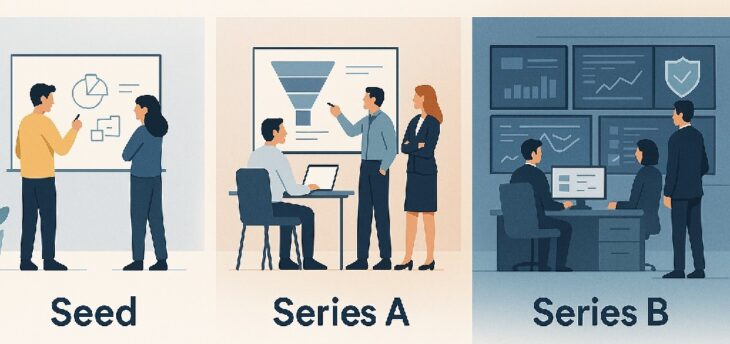
Stage labels differ by geography and industry, but operational expectations normally evolve in a predictable rhythm.
Seed: Prove the Problem and Show Demand Is Real
Seed investors look for a painful problem, a credible wedge, and early signs of retention. At this stage, you want the smallest repeatable motion you can measure.
Nothing fancy. You want just enough revenue or usage to prove that the core loop works and that users or buyers behave in ways that line up with your thesis.
Series A: Prove Repeatability
By A, the question changes from “can you sell” to “can you sell predictably.” You need structured hiring, better internal reporting, a cleaner funnel, and a small but credible base of customers who stick around. You also need early operational discipline, because the next stage will probe everything.
Series B: Prove Scalability and Maturity
Series B capital funds a system, not a batch of experiments. You need maturity across the entire business: product reliability, channel discipline, forecasting, customer success, financial controls, security posture, and documentation.
Diligence grows deeper and wider because investors want to confirm that nothing snaps when growth accelerates.
Below is a practical view of what usually gets checked at each stage.
| Area | Seed | Series A | Series B |
| Product | Clear wedge with early retention | Roadmap tied to revenue progression, improving reliability | Mature platform, scalability, availability, expanding security expectations |
| GTM | Early signals in one or two channels | Repeatable sales motion, reliable pipeline | Multi-channel discipline, efficiency gains, strong forecasting |
| Metrics | Cohorts, early unit economics assumptions | ARR growth, churn, CAC payback, margins | NDR playbook, efficiency framing, burn control |
| Controls and diligence | Basic corporate hygiene | Formal diligence package and clean equity records | Comprehensive diligence across legal, customer calls, contracts, HR, tax, security |
Investors watch the same market data you do. Carta’s broader reports show fewer deals, higher valuations at several stages, and longer waits between rounds. It makes operational maturity a differentiator instead of a bonus.
Build a Diligence-Ready Company, Not a Last-Minute Data Room

Founders often promise to “deal with the data room later.” Later normally arrives during a term sheet negotiation, and the scramble becomes expensive.
A well-run company turns diligence into a simple export of organized facts rather than a stress test to survive.
A few operator habits make that possible.
If you need practical examples of how leadership support firms guide founders through early governance and investor preparation, you can visit website for a clear overview of proven approaches.
Create One Source of Truth for Metrics
Write down your metric definitions and use them everywhere. If ARR, churn, CAC payback, or NDR appear in a pitch deck, they should match the board deck and the financial model. You avoid the number drift that immediately triggers investor concern.
Maintain Clean Board and Consent Hygiene
You need usable minutes, signed approvals for equity grants, major contracts, debt, and key hires. Missing minutes raise governance risks during diligence.
Protect Cap Table Integrity
Document every issuance. Track vesting schedules. Keep your option plan clean. A broken cap table often delays or derails a round.
Run a Monthly Close With Simple Variance Notes
Predictable accounting creates the foundation for every investor conversation. You want a clear explanation of why burn changed, why gross margin shifted, or why revenue timing moved.
Investors probe deeply because diligence is built to uncover risk. Growth-stage investing includes verification across corporate records, equity, financials, IP, customer contracts, employee agreements, and operational posture.
If you treat evidence as a parallel workstream from day one, you avoid rebuilding the foundation while trying to scale.
Seed Stage – Set a Foundation You Will Not Regret Later

Seed founders can tolerate rough edges, but certain errors compound. Repairing them during Series A or Series B becomes slow, expensive, and sometimes impossible.
Corporate and Equity Hygiene
Keep a clean set of materials:
- Formation documents, including updated good standing evidence
- Stock ledger, SAFEs, notes, side letters
- Option plan docs with board approvals and signed agreements
- IP assignment agreements for every founder and contractor
- Clear proof of who owns what, under what terms
A practical benchmark for later stages comes from the NVCA model legal documents, which serve as the industry standard for venture financings.
The most recent update, October 2025, reflects market norms and regulatory changes and gives founders a sense of what well-structured documentation should resemble.
Early GTM
Seed investors do not expect a perfect funnel. They do expect defensible signals.
- Cohort retention and engagement
- A conversion path you can explain clearly
- Pricing logic anchored in customer behavior
- Early unit economics, even if CAC is still directional
The point is to show structured thinking rather than guesses.
Series A: Turn Traction Into a Repeatable Machine

You raise a Series A to scale a motion that already works. Growth alone is not enough.
Investors want structured systems that explain why you grew, what it cost you, and what breaks when you double headcount.
Focus the GTM Motion Instead of Scattering
Index Ventures’ GTM guidance encourages founders to identify one core scalable channel and push structured tests through it.
It suggests giving yourself a defined window, roughly three months, to find traction. That framing prompts discipline.
Operator cues that line up with that guidance:
- Pick one acquisition motion as your primary engine
- Instrument it so CAC, conversion, and funnel shape are measurable
- Scale spend only after you prove that customers stay engaged long enough to justify it
Retention creates rational marketing. Without it, acquisition becomes a leak.
Metrics That Start to Matter at A
Andreessen Horowitz built its Guide to Growth Metrics to clarify what growth investors check. Benchmarks often rotate around:
- ARR growth
- Gross margin
- Gross retention and net dollar retention
- CAC payback
- Sales efficiency
- Burn multiple
If you want a sense of what many software investors reference, the KeyBanc Capital Markets SaaS survey shows operating medians across ARR growth, retention, CAC payback, and quota attainment across 2022 through 2024 estimates.
You do not need to hit medians. You need to show consistent definitions and clean reconciliation to your financials.
Series B: Scale the Machine and Show It Can Be Audited
Series B marks the point where diligence widens. Investors know the company has enough surface area for risk to hide.
They will check everything that touches financial outcomes, operational stability, legal exposure, and customer concentration.
Efficiency and Profitability Expectations Rise Quickly
KeyBanc’s data points to an environment centered on efficient growth. CAC payback, rule-of-40 style framing, and gross margin discipline begin to matter more.
Revenue still needs to grow, but the story must show efficient leverage rather than brute-force spending.
Bessemer’s “Scaling to $100 Million” (updated 2024) gives several targets used by both operators and investors:
- CAC payback targets: SMB under roughly 12 months, mid-market under roughly 18, enterprise under roughly 24
- CLTV to CAC around 3x or better
- Strong gross margin as a key driver of cloud economics
- Continued weight of sales and marketing costs even at scale
Investors do not require perfection. They require coherence. The numbers must reconcile with your financial outputs and with your model’s logic.
What Actually Gets Checked
Diligence is not a single checklist. It is a set of investigative paths designed to uncover risk.
A useful way to think about it is folder-first, built around common request categories. Cooley’s diligence lists follow this structure across corporate, equity, material agreements, IP, employment, litigation, and financial areas.
Kruze Consulting highlights how scope expands across stages, with Series B requiring deeper metrics, more complex accounting records, and a heavier HR and legal review.
A Data Room Blueprint That Works
| Folder | Examples | Why Investors Care |
| Corporate | Charter, bylaws, minutes, consents | Confirms authority, governance, and decision history |
| Cap table and securities | Stock ledger, SAFEs, notes, option plan | Verifies ownership, dilution, and hidden claims |
| Financials | P&L, balance sheet, cash flow, budget vs actual | Validates burn, runway, predictability |
| Customers and revenue | Top contracts, pricing, pipeline, churn cohorts | Tests repeatability, concentration, and quality |
| IP | Assignments, patents, OSS policy, licenses | Confirms you own the product you sell |
| People | Offer letters, agreements, incentive plans | Exposes misclassification and liability risk |
| Security and privacy | Policies, incident history, audit reports | Evaluates operational and regulatory exposure |
| Litigation and compliance | Dispute log, claims | Surfaces catastrophic downside scenarios |
Diligence works best when your records do not contradict each other.
Security and Compliance

Enterprise buyers, regulated markets, and modern investors all view security as part of the maturity story. Even if no one demands a SOC 2 report yet, you must show that your program has structure.
The AICPA defines SOC 2 as an examination of your controls related to security, availability, processing integrity, confidentiality, or privacy. You do not need a full audit early, but you do need evidence that you intend to reach a proper posture.
NIST’s Cybersecurity Framework 2.0 adds a Govern category that forces clarity around oversight. The framework still centers on Identify, Protect, Detect, Respond, and Recover, but Govern pushes founders to show ownership and accountability. It helps frame the argument that security is woven into product decisions and operational processes.
Practical signals investors look for:
- Access controls documented and enforced
- Incident response steps written down
- A clear security owner
- Policies that reflect real behavior
Even a light structure goes a long way.
Make Your Metrics Diligence-Proof

Metrics fall apart during diligence in two predictable ways.
Problem 1: Definitions Drift Over Time
If ARR appears in pitch decks, financial models, and board decks with slight differences, investors pick up on it immediately. It sets off alarm bells.
Problem 2: Numbers Do Not Reconcile
If revenue forecasts, actual revenue, bookings, and pipeline metrics cannot be traced back to accounting, investors lose trust.
Andreessen Horowitz warns about organizational behaviors like confirmation bias and “numbers-gaming.” Reliable metrics come from consistent processes and written definitions.
A Simple Operator System That Holds up Under Scrutiny
- Write a one-page KPI definitions document
- Reconcile board decks to finance outputs every month
- Track cohorts for retention, expansion, and payback
- Version your model and save every revision with a timestamp
Predictable, traceable metrics protect you during diligence.
Classic Landmines Between A and B
Founders often encounter the same avoidable problems.
- Missing board approvals for equity
- Undocumented option grants
- Broken IP chain of title
- Customer contracts with hidden terms that weaken revenue quality
- Security claims without controls behind them
- Metrics calculated differently across documents
- Weak financial close process
Each one slows a fundraise and sometimes kills it outright.
A Practical Six-Week Diligence Readiness Sprint
If your foundation is reasonably clean, you can compress a readiness cycle into six focused weeks. Many teams run this playbook before every fundraiser.
Week 1: Corporate and Cap Table

- Update minutes and board consents
- Ensure option grants are fully documented
- Index all SAFEs, notes, and side letters
Week 2: Legal and IP
- Make sure all IP assignments are executed
- Organize top customer and vendor contracts
- Create a clear dispute log
Week 3: Financials
- Produce clean monthly financials
- Build a budget vs actual package
- Update your runway analysis and hiring assumptions
Week 4: Metrics
- Finalize your KPI definitions document
- Prepare retention and expansion cohorts
- Align unit economics with the financial model
Week 5: Security and Compliance
- Document policies and access controls
- Create an incident response outline
- Prepare a SOC 2 roadmap if relevant
- Map ownership using the CSF 2.0 structure
Week 6: Narrative Alignment
- Align the pitch deck, data room, and model
- Identify reference customers
- Prepare a “known issues” memo so no surprise lands late in diligence
A repeatable sprint ensures every fundraise starts from a position of confidence rather than panic.
Closing Notes
Scaling from seed to Series B asks founders to run two parallel jobs with equal precision. One job builds the machine. The other builds the evidence that the machine works. Markets reward operational clarity right now.
Teams that treat diligence as a constant discipline rather than a scramble are the ones that raise efficiently, avoid painful surprises, and preserve optionality when timelines stretch.