Hiring an employee can cost considerably more than the salary listed in the employment contract. For businesses planning to grow, understanding employee compensation is an important part of calculating the full cost of each new hire.
In several countries, businesses must contribute to national health insurance or social security programs. In others, employers largely provide private medical coverage, making insurance an important part of recruitment and employee benefits.
The financial difference can be substantial. A company hiring in South Korea must contribute to a national health insurance system, while a business in Hong Kong can generally decide how much private medical coverage to provide. Employers in Japan, India and the Philippines face different contribution rates, eligibility rules and payment limits.
We chose to write about Asia because it is a growing market with many new companies entering, especially from China. A lot of companies operating in some Western countries are also planning to move to the East, if they haven’t already. So, it is good to know about all possible expenses you could face when starting a business.
How Much Do Employers Pay for Health Insurance in Asia?
There is no standard employer health insurance rate across Asia. Companies starting a business in another country must also account for differences in employment laws, tax requirements and local operating expenses.
Each country has its own system, and some combine healthcare funding with pensions, disability benefits and other social insurance programs.
For example, South Korea requires employers and employees to share national health insurance contributions. Singapore uses the Central Provident Fund, which includes healthcare savings alongside retirement and housing-related savings. Hong Kong does not generally require employers to purchase ordinary private medical insurance for their staff.
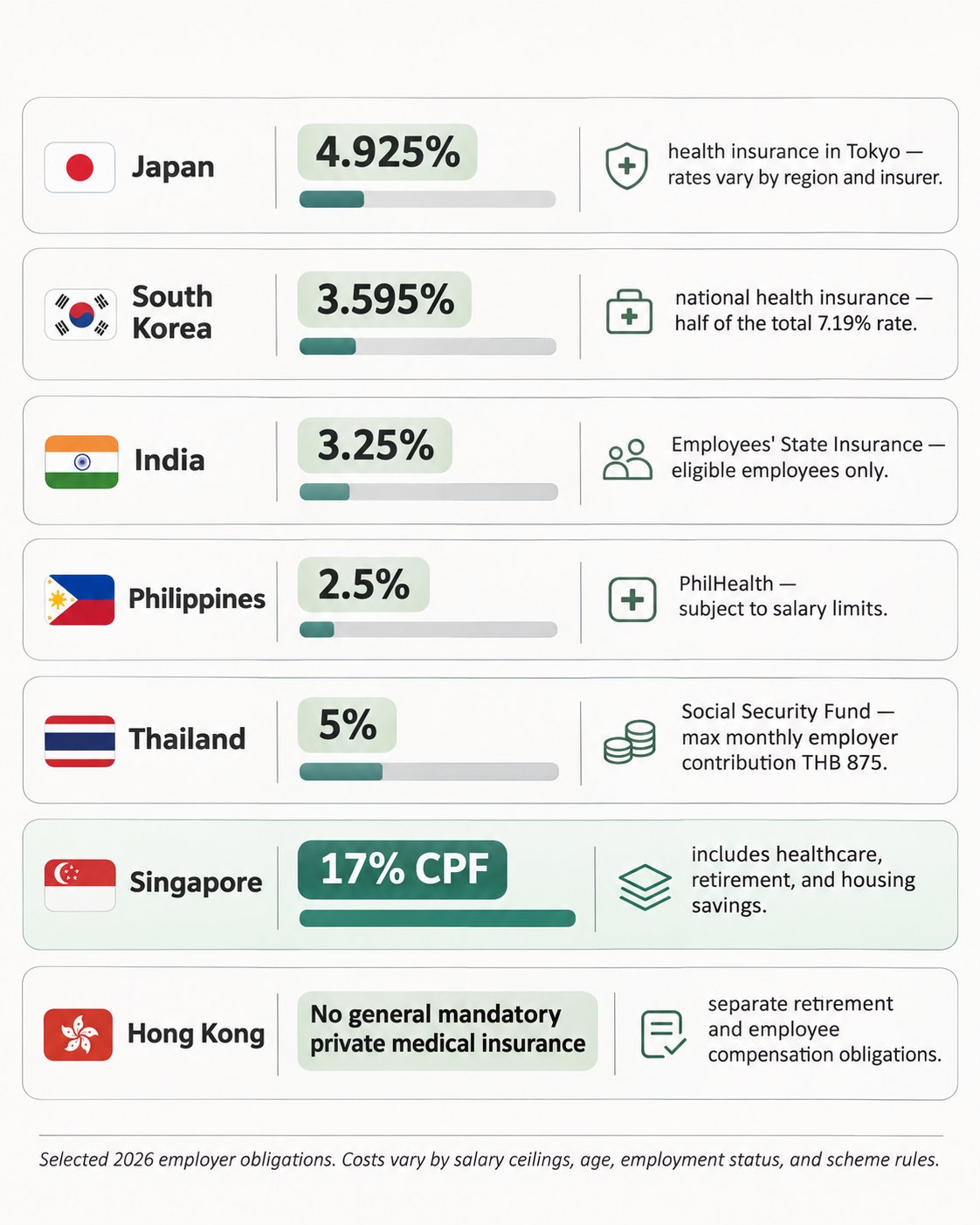
The table below compares selected employer obligations using contribution rates applicable in 2026.
| Country or Market | Employer Contribution | Important Details |
| Japan | 4.925% for health insurance in Tokyo under the Japan Health Insurance Association | Rates vary by region and insurer, with additional social insurance obligations |
| South Korea | 3.595% for national health insurance | Half of the total 7.19% contribution rate, excluding additional long-term care contributions |
| India | 3.25% under the Employees’ State Insurance scheme | Applies to eligible employees and covered establishments |
| Philippines | 2.5% for PhilHealth | Half of the total 5% contribution, subject to the applicable salary limits |
| Thailand | 5% toward the Social Security Fund | Maximum monthly employer contribution of THB 875 in 2026 |
| Singapore | 17% CPF for employees aged 55 and below under standard rates | Not solely health insurance, as CPF also finances retirement and housing-related savings |
| Hong Kong | No general mandatory private medical insurance contribution | Separate mandatory retirement and employee compensation insurance obligations apply |
Figures apply to the specified schemes and employee categories. They are not directly comparable national averages. Salary ceilings, age, employment status and additional contributions can change the employer cost.
Employer Health Insurance Costs in Major Asian Countries
The main difference between Asian markets is how healthcare contributions are collected. Some countries calculate payments as a percentage of wages, while others impose contribution ceilings or rely more heavily on voluntary employer benefits.
Japan
Employers in Japan generally share mandatory employee health insurance contributions with workers.
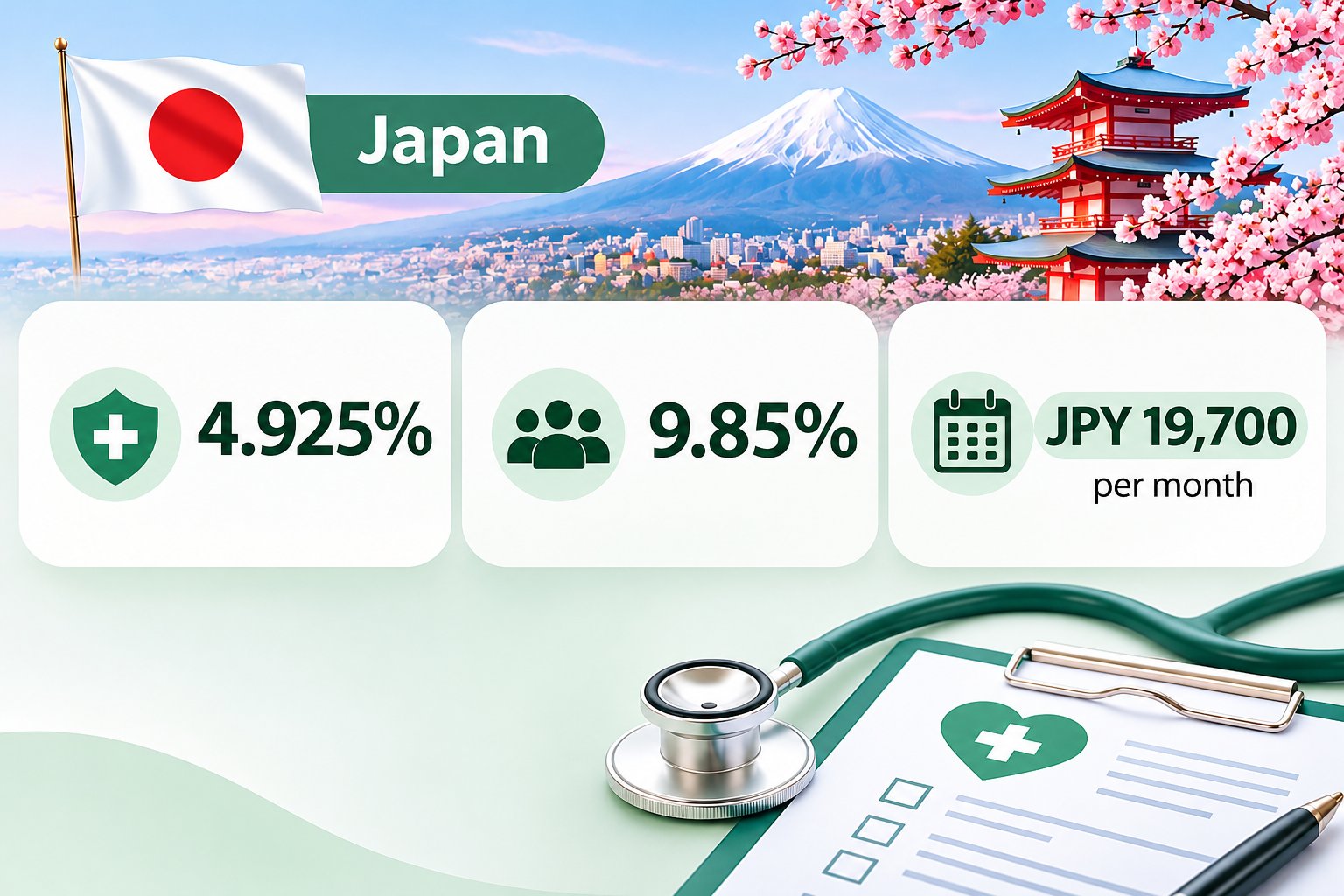
Under the Japan Health Insurance Association, the total health insurance premium rate for Tokyo is 9.85% as of March 2026. Employers and employees each pay 4.925% of the applicable standard remuneration.
Consider an employee with monthly standard remuneration of JPY 400,000. The employer health insurance contribution would be JPY 19,700 per month at the Tokyo rate.
That equals JPY 236,400 annually for one employee, before additional social insurance contributions.
The Japan Pension Service explains that eligible workplaces must enroll covered employees in employee health insurance and pension insurance.
Businesses must also budget for pension contributions and other statutory payments. Companies employing people aged 40 to 64 may face additional long-term care insurance contributions.
South Korea
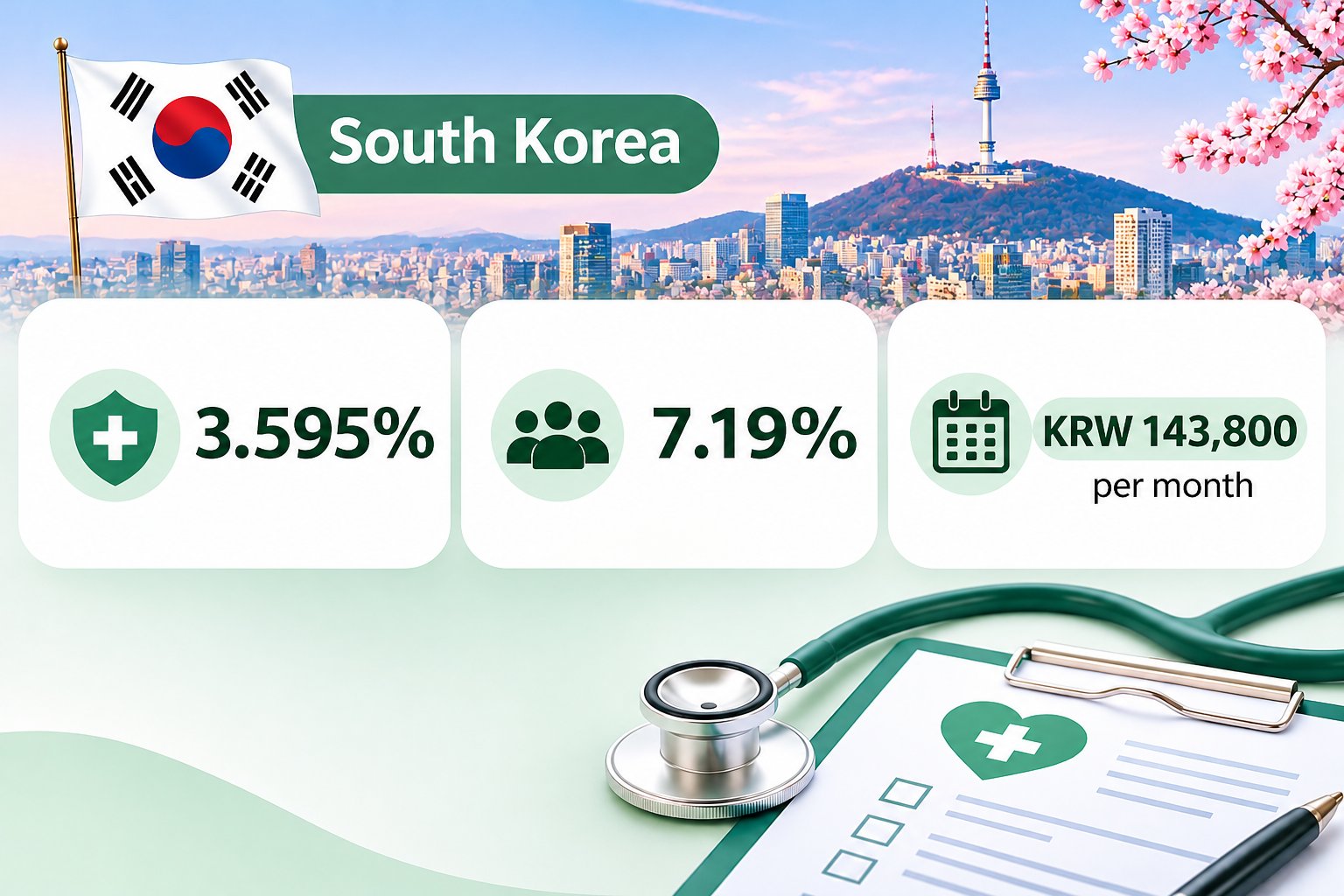
South Korea operates a national health insurance system financed through contributions paid by employees and employers.
According to the National Health Insurance Service, the contribution rate for employed subscribers is 7.19% in 2026, shared equally between employer and employee.
An employer therefore pays 3.595% of the applicable monthly wage for national health insurance.
For an employee earning KRW 4 million per month, the employer contribution would be KRW 143,800, excluding the additional long-term care insurance contribution.
When hiring several employees, this becomes a recurring expense that increases with payroll. Salary adjustments can also raise the amount the employer contributes.
India
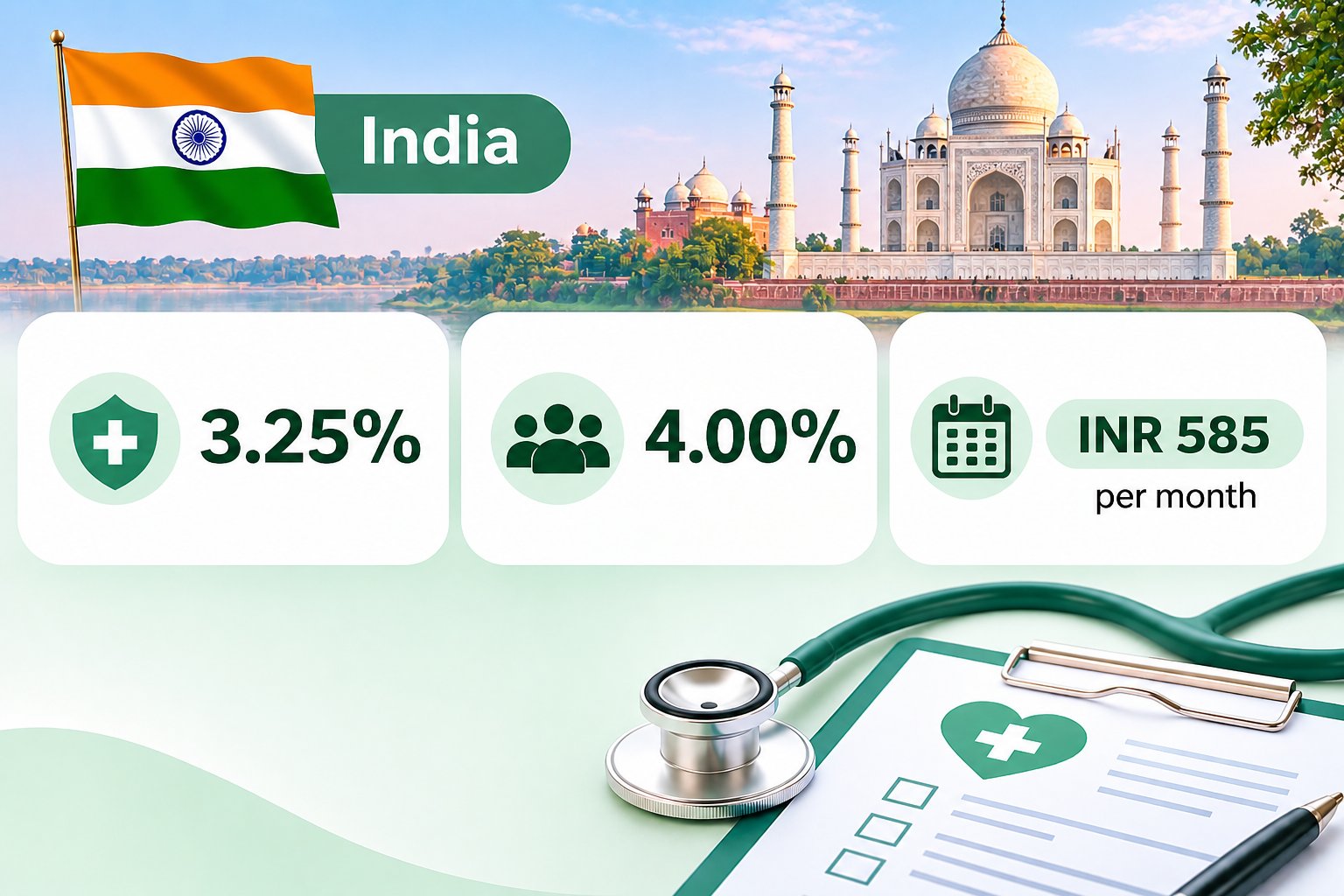
India uses the Employees’ State Insurance scheme to provide medical and other social insurance benefits to eligible workers.
The employer contribution is 3.25% of eligible wages, while the employee contribution is 0.75%.
According to the Employees’ State Insurance Corporation, the scheme applies to covered establishments and eligible employees under the relevant wage and employment rules.
For a covered employee earning INR 18,000 per month, the employer contribution would be INR 585.
However, the ESI system does not cover every employee in India. Companies hiring professionals outside the applicable eligibility limits may purchase separate group health insurance instead.
The cost of that additional coverage depends on the policy, employee age profile, insured amount and included benefits.
Philippines
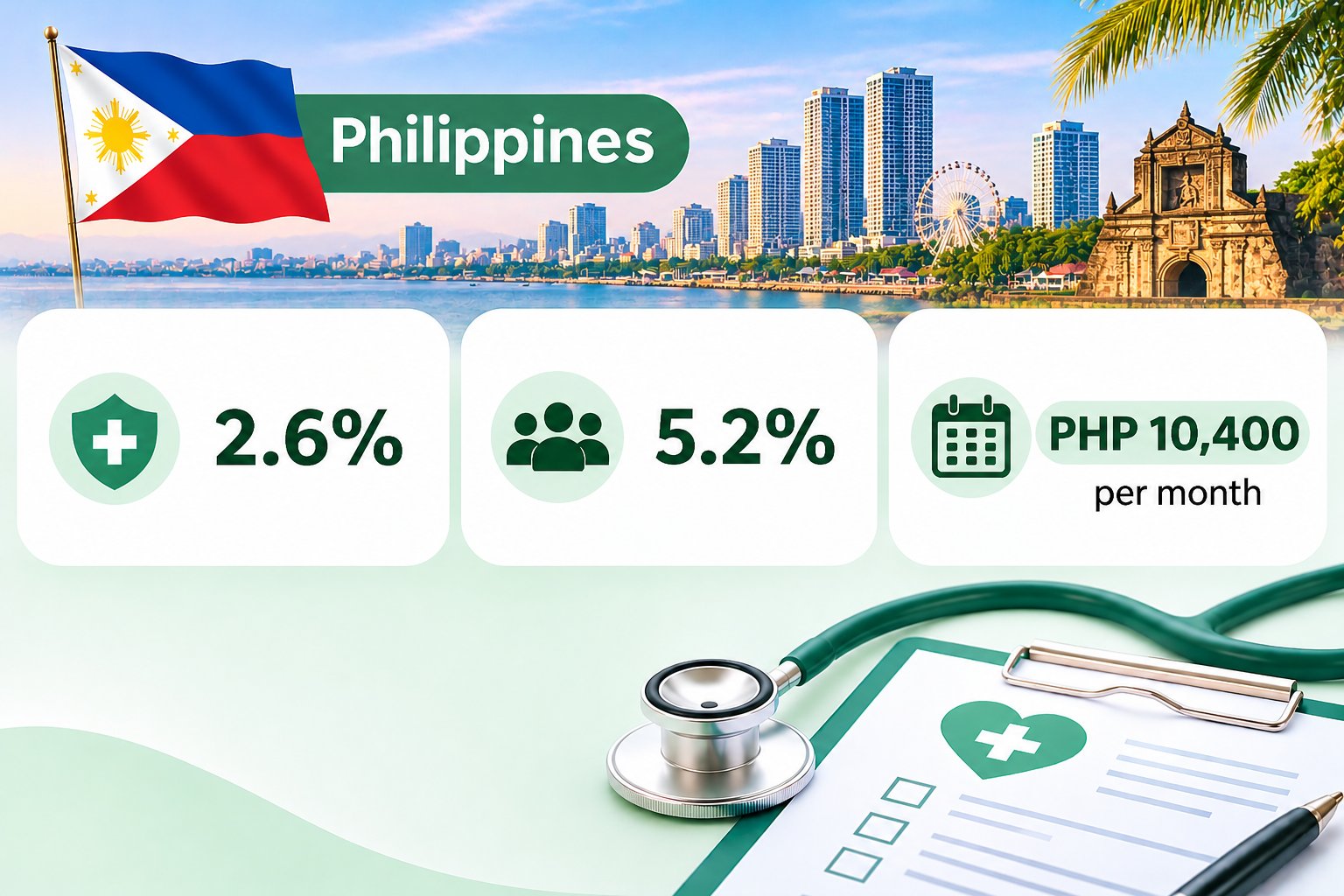
In the Philippines, employers and employees share contributions to the national health insurance program administered by PhilHealth.
The total premium contribution rate remains 5% in 2026, divided equally between employers and employees.
According to the Philippine Information Agency, the monthly premium is calculated using a salary floor of PHP 10,000 and a ceiling of PHP 100,000.
An employee earning PHP 40,000 per month generates a total PhilHealth contribution of PHP 2,000. The employer pays PHP 1,000, and the employee pays the remaining PHP 1,000.
Employers may also provide private health maintenance organization coverage, commonly known as HMO benefits.
Those benefits are separate from the mandatory PhilHealth contribution and create an additional expense for companies that include them in employment packages.
Thailand
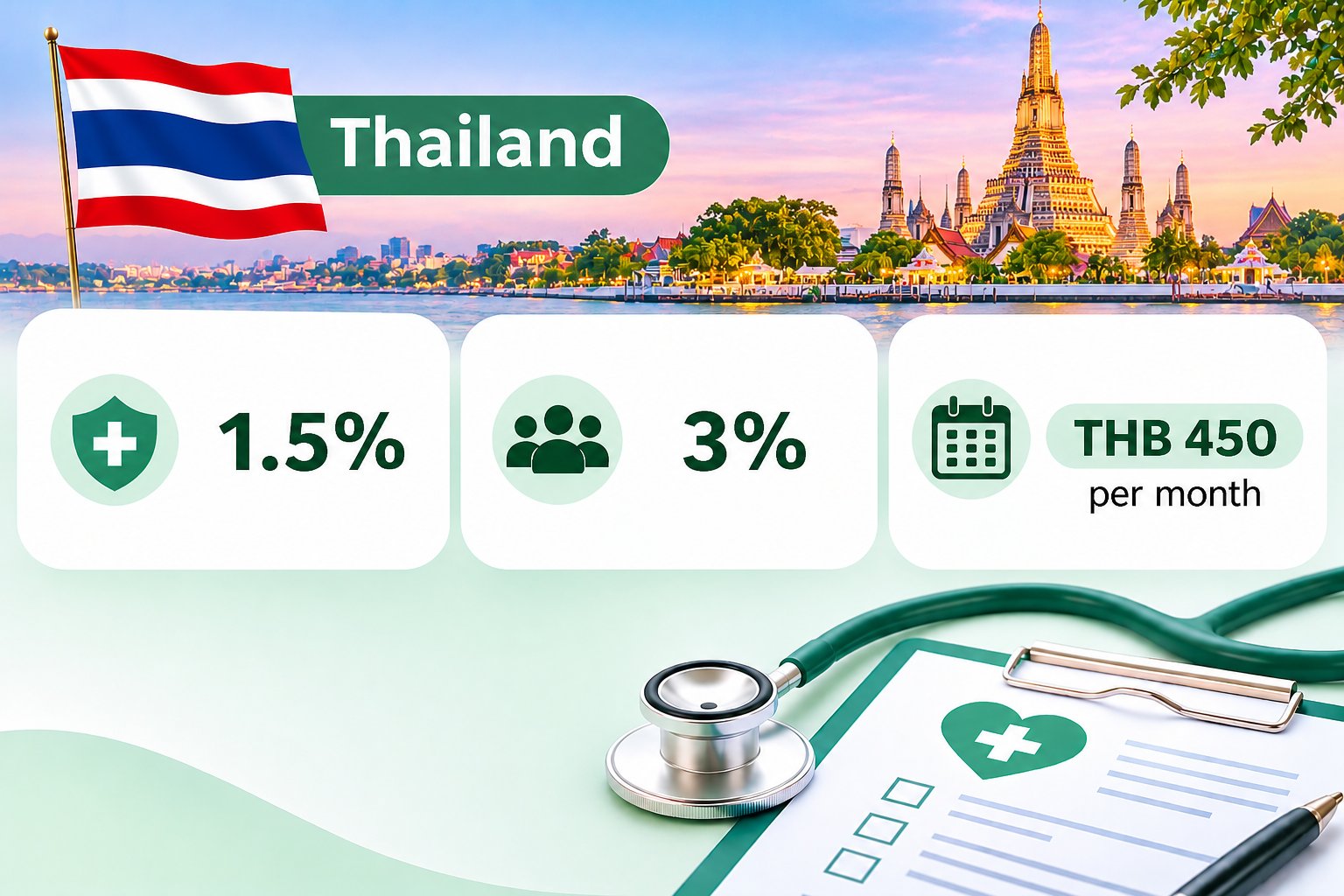
Thailand requires covered employees and employers to contribute to the Social Security Fund.
In 2026, the employer contribution is generally 5% of eligible wages, with a maximum monthly contribution of THB 875 under the revised wage ceiling of THB 17,500.
The previous contribution ceiling was lower. The revised rules took effect on January 1, 2026, increasing the maximum contribution for both employers and employees.
According to Baker McKenzie, the monthly ceiling is scheduled to increase again in 2029 and 2032.
For companies with large workforces, even a modest increase in the monthly contribution cap can affect annual payroll expenses.
Singapore
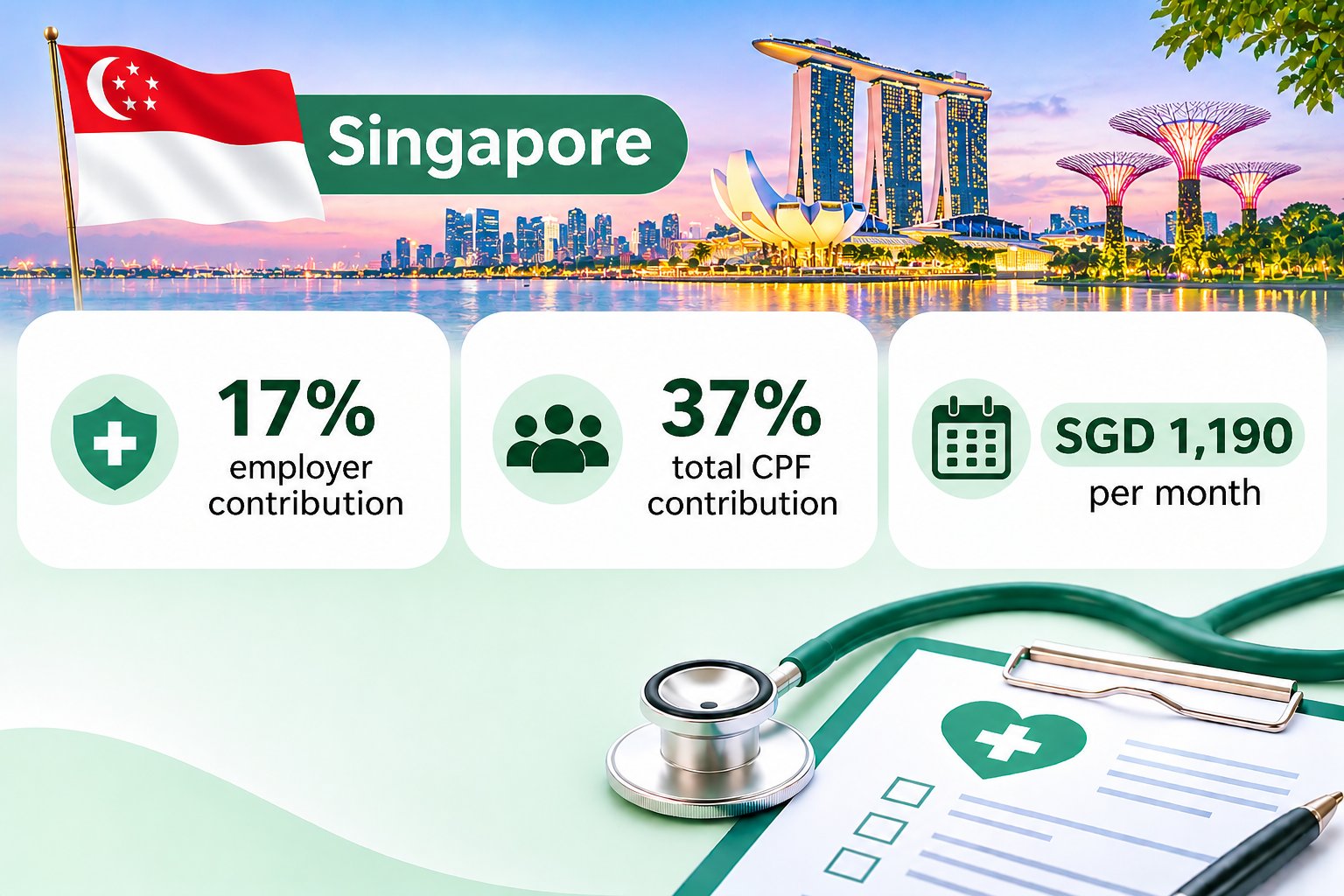
Singapore finances part of its healthcare system through the Central Provident Fund, particularly the MediSave component.
The CPF system is broader than medical insurance. Contributions also support retirement and housing-related savings.
For Singapore citizens and qualifying permanent residents aged 55 and below, the standard employer contribution rate is 17% of eligible wages in 2026.
According to the Central Provident Fund Board, rates differ according to employee age, residency status and applicable wage limits.
For an employee earning SGD 5,000 per month, the standard employer CPF contribution would be SGD 850.
That contribution should not be recorded entirely as a health insurance expense because CPF funds several types of benefits.
Businesses may also purchase group medical insurance to cover private healthcare expenses beyond statutory arrangements.
Hong Kong
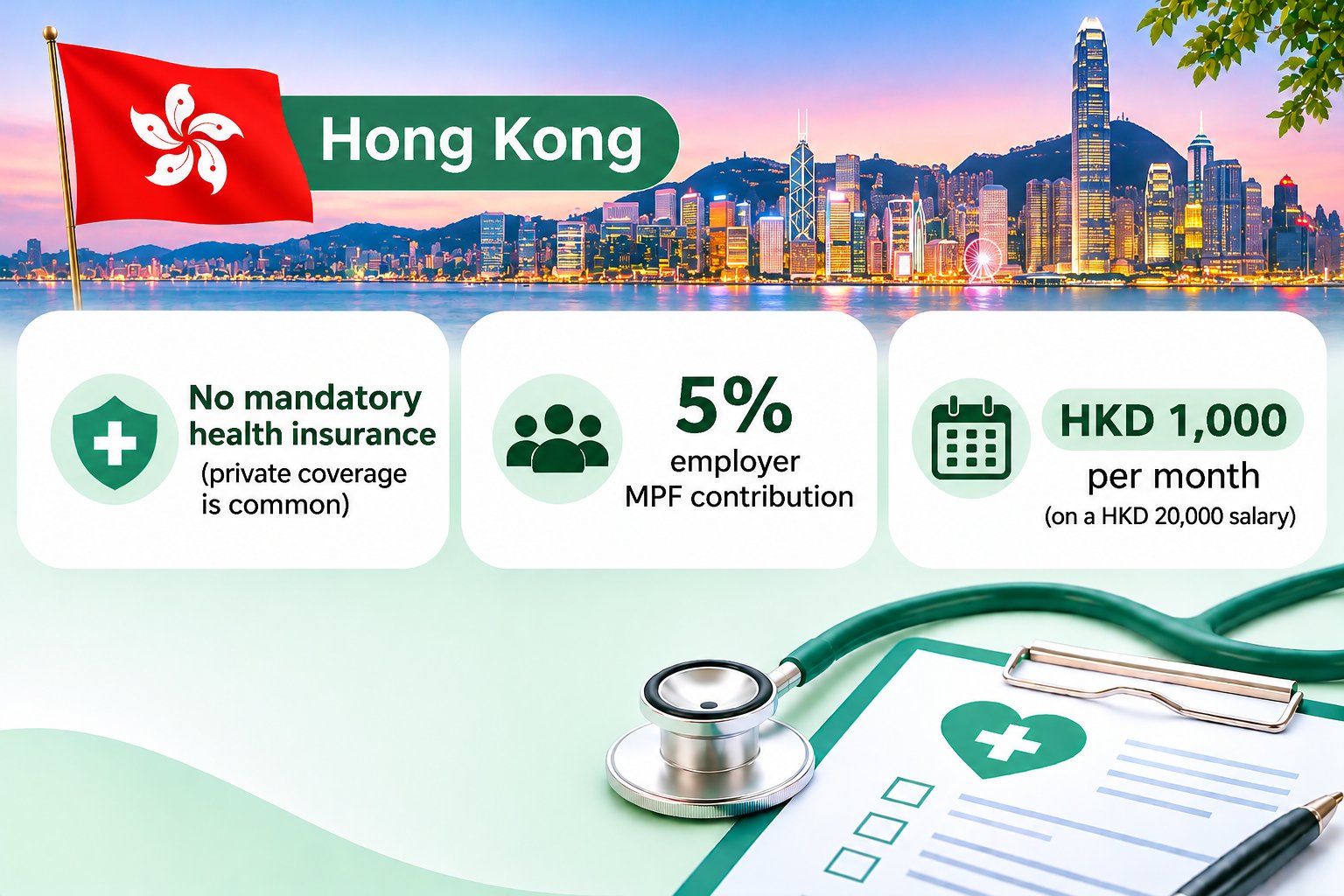
Hong Kong differs from markets that require employers to contribute a fixed percentage of salaries toward national employee medical insurance.
Ordinary employer-provided private health insurance is generally voluntary. However, employers must meet separate legal obligations, including Mandatory Provident Fund retirement contributions and employees’ compensation insurance.
The Mandatory Provident Fund Schemes Authority states that employers generally contribute 5% of relevant employee income to MPF, subject to a maximum monthly mandatory contribution of HKD 1,500.
Private medical insurance is an additional benefit that many businesses consider when building employment packages.
In Hong Kong, insurers such as FWD offer medical insurance products through online channels, giving individuals another way to compare private coverage alongside any medical benefits provided by their employers.
Employers considering separate group medical insurance should obtain quotations based on their workforce rather than treating individual policy prices as group insurance rates.
How Health Insurance Costs Affect Business Expenses?
Health insurance affects more than the monthly payroll calculation. It also influences recruitment budgets, cash flow and the cost of expanding into another country.
Higher Total Employment Costs
Salary is only one part of the amount a company spends on each employee.
An employer may also pay health insurance contributions, pensions, unemployment insurance, workers’ compensation premiums and voluntary employee benefits.
Consider two companies offering equivalent salaries in different Asian markets. Their total employment costs can differ because each country imposes different contribution rates and salary ceilings.
Businesses that compare salaries without statutory employment costs risk underestimating their actual hiring budgets.
Overlooking these expenses is one of several financial mistakes in small business growth that can put pressure on cash flow.
More Expensive Workforce Expansion
Mandatory contributions become more significant as headcount increases.
For example, a company employing 50 workers in South Korea at an applicable monthly salary of KRW 4 million would pay KRW 7.19 million per month toward national health insurance alone.
That equals KRW 86.28 million annually, assuming salaries and the contribution rate remain unchanged.
Additional long-term care insurance and other employment contributions would increase the total.
Businesses planning expansion should calculate these expenses before approving new positions.
Applying smart budgeting and cost-control strategies can help businesses prepare for rising employment expenses while protecting their financial resources.
Competition for Employees

In markets where private medical coverage is voluntary, companies can use employee health benefits as part of their compensation packages.
Private insurance may help employees access services outside the standard public system or reduce certain personal medical expenses, depending on policy terms.
However, benefits should match the needs of the workforce. An expensive policy with limited access to relevant providers may deliver less value than a simpler plan with suitable outpatient coverage.
Health benefits can influence employee satisfaction and recruitment, but businesses should evaluate them alongside salary, working conditions and opportunities for career development.
Insurance Premium Renewals
Private group medical insurance introduces costs that can change when a policy is renewed.
Insurers may consider claims history, employee demographics, plan design, medical inflation and the size of the insured group.
A growing company may receive different premium terms as its workforce changes.
Finance teams should therefore budget for potential renewal increases rather than assuming that the initial premium will remain fixed.
Regularly reviewing insurance expenses alongside other business costs is also an important part of financial planning and cost control.
Conclusion
Employer health insurance costs across Asia vary because governments finance healthcare in different ways. South Korea and the Philippines use defined national health insurance contribution rates. Japan operates mandatory employee insurance with rates that vary by insurer and region. Hong Kong gives employers greater flexibility over ordinary private medical benefits.
For businesses operating in multiple countries, the largest budgeting mistake is comparing salaries without including statutory contributions and optional insurance expenses.
A reliable workforce budget should calculate each required contribution, account for private coverage and allow for changes in premiums or regulations. That gives businesses a clearer picture of the actual cost of hiring employees across Asian markets.