
A business generating $800,000 in annual revenue is not necessarily worth $800,000. A buyer will want to know how much profit remains after expenses, how stable that profit is, and how much money the business will need to keep operating.
Two companies with similar revenue can sell for very different amounts. One might depend entirely on its founder, and the other might have reliable contracts, experienced employees, and customers who have been buying for years.
Before setting an asking price, you need to examine your financial records, calculate the earnings a buyer can expect, and compare your company with similar businesses that have sold.
Start by Reviewing Your Financial Records
Your financial records provide the starting point for estimating the value of your business. Buyers need evidence that the company earns what you claim, so an estimate based on a successful month or a particularly profitable year will not be enough.
- Income statements showing revenue, operating expenses, and profit.
- Balance sheets listing company assets, outstanding debts, and other liabilities.
- Cash flow statements showing the money entering and leaving the business.
- Tax returns that buyers can compare with your accounting records.
- Customer and supplier contracts showing existing obligations and expected income.
Look at changes in your financial performance. A business that earned $150,000 last year after earning $80,000 the previous year needs an explanation for the increase.
Perhaps you signed an important new customer, increased prices, or reduced operating costs. Buyers will want evidence that the improvement can continue under new ownership.
Calculate How Much the Business Actually Earns

Business owners sometimes confuse revenue, net profit, and the earnings used in a sale valuation.
Revenue tells you how much money the company generates through sales. Net profit shows what remains after accounting expenses. Valuation calculations may use an adjusted earnings figure that accounts for the way the current owner operates the company.
Seller’s Discretionary Earnings for Small Businesses
For smaller businesses where the owner handles daily operations, buyers and business brokers frequently examine Seller’s Discretionary Earnings, or SDE.
The International Business Brokers Association’s definition of discretionary earnings includes earnings before interest, income taxes, depreciation, amortization, one owner’s compensation, and qualifying nonrecurring or personal expenses paid by the company.
Consider a hypothetical small business with the following annual financial results.
| Financial Item | Annual Amount |
| Net income before taxes | $85,000 |
| Interest expense | $8,000 |
| Depreciation and amortization | $12,000 |
| Owner’s salary and benefits | $70,000 |
| Documented one-time legal expense | $5,000 |
| Total Seller’s Discretionary Earnings | $180,000 |
Under the assumptions in the example, the business generates $180,000 in annual SDE.
However, the calculation does not mean a new owner can automatically withdraw $180,000 every year. An owner who currently handles sales, customer support, and administration may need to be replaced by paid employees.
Only genuine, documented adjustments belong in the calculation. Ordinary expenses that will continue after the sale cannot simply be removed to make the company appear more profitable.
EBITDA for Businesses With Established Management
Larger businesses with employees managing daily operations are frequently valued using EBITDA, which stands for earnings before interest, taxes, depreciation, and amortization.
EBITDA helps buyers compare operating performance without some financing and accounting differences. However, it does not account for every cash expense. Equipment purchases, changes in working capital, and taxes can still affect the money available to a new owner.
A business with a management team already in place may be easier for an investor to operate without hiring several additional employees.
Estimate Business Value Using an Earnings Multiple
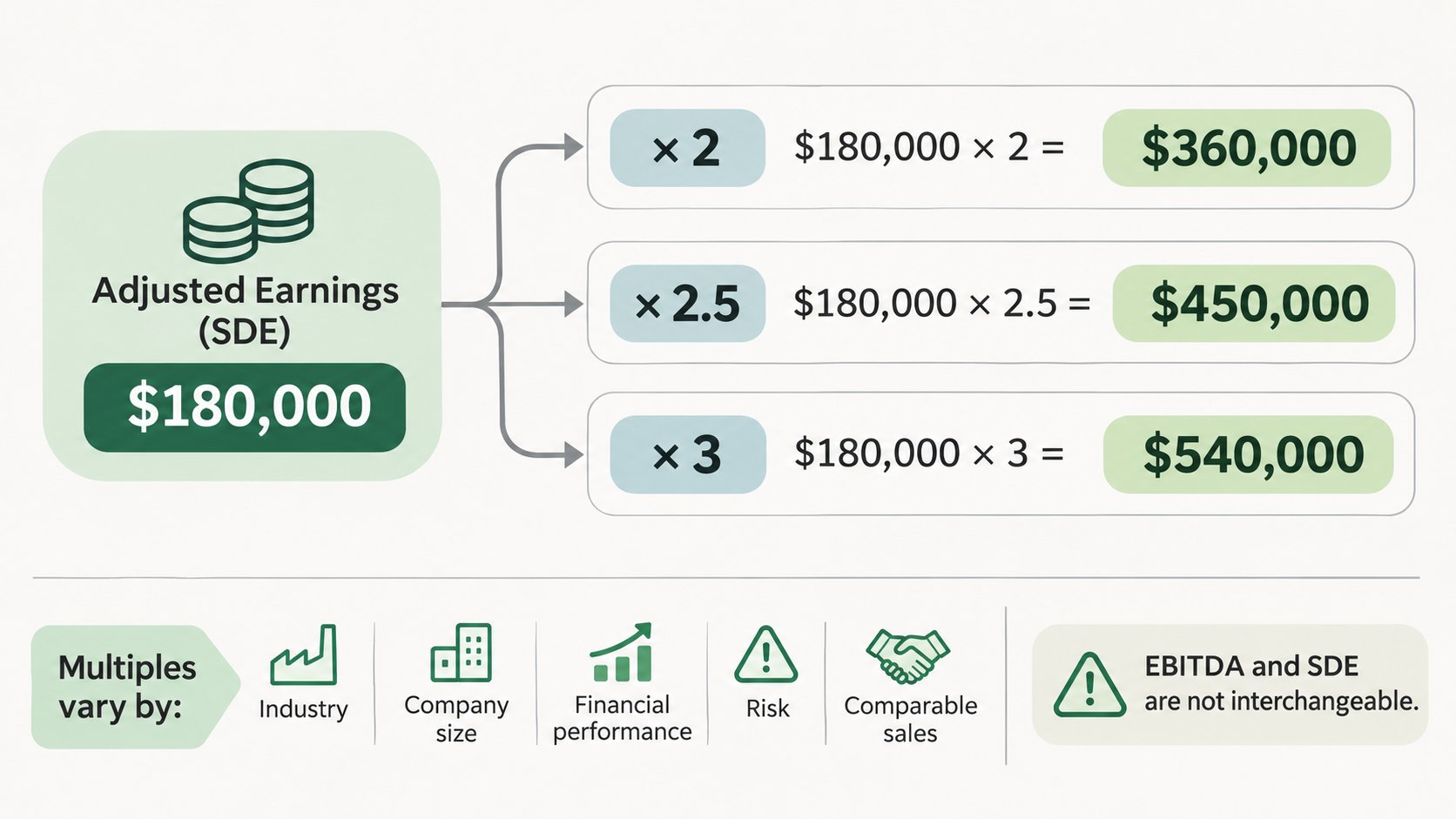
Once you calculate the earnings, you can estimate the business value by applying a multiple.
The basic calculation is straightforward.
Business value = Adjusted annual earnings × Valuation multiple
Suppose the business in our earlier example generates $180,000 in annual SDE. Different assumed multiples would produce the following estimates.
- At 2 times earnings, the estimated value is $360,000.
- At 2.5 times earnings, the estimated value is $450,000.
- At 3 times earnings, the estimated value is $540,000.
The multiples above are illustrative calculations, not recommended market rates. Actual multiples depend on the industry, size of the business, financial performance, risk, and prices achieved in comparable transactions.
A buyer might agree to pay more for a business with steady earnings and a management team that can continue operating independently. A company experiencing falling profits or losing important customers may receive a lower offer.
Be careful when researching industry multiples online. A multiple based on EBITDA cannot be applied directly to SDE without accounting for the difference between the two earnings measures.
Compare Your Business With Similar Companies That Have Sold
Recent business sales can help establish a realistic price range, especially when the companies operate in the same industry and have similar financial performance.
The Small Business Administration’s guidance on selling a business identifies three main valuation approaches.
- Income approach examines the income or cash flow the company is expected to generate, accounting for risk.
- Market approach compares the company with similar businesses that have been sold.
- Asset approach considers the value of business assets after deducting liabilities.
For market comparisons, look for completed transactions rather than advertised asking prices. A business listed for $900,000 might eventually sell for considerably less.
Compare businesses with similar revenue, earnings, customer relationships, and operating structures. A local restaurant, an online store, and a software subscription company can have completely different valuation profiles even if their annual revenue is identical.
Business brokers and valuation professionals may have access to transaction information that individual owners cannot easily obtain.
Account for Equipment, Inventory, and Other Assets

Business value can also depend on what the company owns.
A manufacturing business might own expensive machinery, commercial vehicles, and a factory building. An online business could have limited physical property but own valuable software, a recognized brand, or established customer relationships.
- Machinery, vehicles, computers, and equipment.
- Inventory that can realistically be sold.
- Commercial property owned by the business.
- Software, patents, trademarks, and other intellectual property.
- Accounts receivable and other financial assets.
Asset values should reflect their actual economic worth rather than automatically relying on original purchase prices.
For example, a machine purchased for $100,000 several years ago might have a much lower resale value today. An established software product, meanwhile, could generate substantial income despite having relatively little physical equipment.
Avoid counting the same value twice. If your earnings-based valuation already includes the equipment and normal inventory required to operate the company, adding their full value again could exaggerate the selling price.
Assets excluded under the agreed sale terms may require separate treatment. Real estate, excess cash, and surplus equipment are examples worth discussing with the buyer.
Identify Problems That Could Reduce Your Business Value

Strong profits alone do not guarantee an attractive offer. Buyers will examine the risks associated with continuing the business after the current owner leaves.
Dependence on a Small Number of Customers
Imagine that one customer accounts for 40% of annual sales. Losing that account could have a serious effect on revenue, particularly if the customer can cancel its contract with little notice.
A company serving hundreds of independent customers may have less exposure to the loss of any single account. Contract duration, payment history, and customer retention also affect the assessment.
Too Much Dependence on the Owner
Some profitable businesses depend almost entirely on the founder.
The owner might personally manage every major customer, approve purchases, negotiate contracts, and handle technical problems. A buyer would need to take over those responsibilities or hire people capable of performing them.
Documented procedures and experienced managers can make the ownership transition easier. Buyers can also evaluate the operating costs more accurately when employee responsibilities are clearly defined.
Expenses That Could Increase After the Sale
Current profit may not represent future earnings if major expenses are approaching.
A buyer could discover that equipment needs replacing, an important lease is about to expire, or several employees are due for salary increases.
Review known expenses before estimating future profitability. An unusually profitable year may be less valuable if the business will need substantial investment immediately after the acquisition.
Consider How Different Buyers Might Value Your Company
Two interested buyers can review the same financial statements and arrive at different offers.
An individual buyer might evaluate a small business based on the income it can provide after taking over daily operations. An established competitor may also consider potential cost savings, additional customers, or access to a new market.
For founders selling established software companies, a permanent capital partner can be relevant when the goal is to transfer ownership to a buyer intending to operate the business over the long term.
That kind of buyer may assess the durability of subscription revenue, customer retention, product development needs, and the people responsible for maintaining the software.
Buyer priorities can influence the proposed price, payment structure, and future responsibilities of the founder. Comparing offers requires looking at those conditions alongside the amount offered.

Calculate How Much Money You Would Receive After Selling
A business valuation is not necessarily the amount of money the seller receives at closing.
Debt, transaction expenses, cash adjustments, and the agreed payment structure can change the final amount substantially.
Consider a hypothetical transaction with the following terms.
| Transaction Item | Amount |
| Agreed enterprise value | $450,000 |
| Debt settled at closing | -$60,000 |
| Excess business cash included in the equity value | +$20,000 |
| Broker, legal, and transaction fees | -$15,000 |
| Estimated proceeds before taxes | $395,000 |
The example assumes a debt-free, cash-free enterprise valuation, no additional working capital adjustments, and full payment at closing.
Actual sale agreements can treat debt, cash, inventory, and working capital differently. Taxes will also depend on the business structure, the assets or shares being sold, and applicable tax rules.
Payment timing deserves attention as well. An offer of $500,000 paid entirely at closing is different from an offer of $500,000 that includes $100,000 payable only if the business achieves certain targets after the sale.
Seller financing creates another consideration. If the buyer pays part of the purchase price over several years, the seller assumes the risk of delayed or missed payments.
Should You Hire a Professional Business Valuator?

You can prepare an initial estimate using your financial statements and comparable sales. However, a professional valuation becomes more useful when your business has complicated ownership arrangements, substantial intellectual property, unusual financial adjustments, or a significant amount of debt.
The IRS business valuation guidelines identify several factors that appraisers examine, including earning capacity, financial condition, industry outlook, comparable investments, and the ability to control the business.
A qualified business appraiser can explain the assumptions behind an estimated value and document how the figures were calculated.
A business broker may also help assess comparable transactions and likely buyer interest. Your accountant can review financial adjustments, and a tax professional can estimate the consequences of different sale structures.
Professional advice is especially useful when the valuation will affect negotiations between several owners or when the proposed transaction contains significant conditional payments.
Set an Asking Price You Can Defend
A useful valuation should give you a reasonable price range rather than an unsupported single figure.
Suppose comparable transactions and your financial results suggest a value between $400,000 and $500,000. A higher asking price might be justified if the company has valuable assets outside the operating valuation or contracted income that supports a premium.
However, setting a $750,000 price simply because you spent ten years building the company will not persuade a buyer to pay it.
Before approaching potential buyers, prepare a short financial summary showing annual earnings, the adjustments used to calculate them, comparable sales, and the assumptions supporting your price.
Once the valuation is established, the process of selling a business continues with identifying buyers, negotiating terms, reviewing financial records, and completing the purchase agreement.
Keep the financial information used in your valuation up to date during negotiations. If a major customer leaves or earnings change significantly, the buyer may revise the offer even after an initial price has been discussed