
You can’t register a German GmbH without €25,000 in share capital, yet you can open a UK private limited company with a symbolic amount. That gap alone shows how much the rules shift from one country to the next.
The legal structure you pick for your first foreign entity decides which taxes you pay, who is liable for debts, and how fast you can start operating. You can change it later, but restructuring almost always costs more than getting it right at the start. Below are the three options you’ll most likely weigh, plus clear criteria for choosing between them.
If you need a quick overview before talking to an advisor, this table sums up the essentials. It won’t replace a local check, but it will help you ask the right questions.
| Structure | When It Makes Sense | Main Risk |
| Branch | Existing clients, local support, decisions kept at headquarters | Parent company liable for all obligations |
| Subsidiary | Local sales, hiring, regulated industries | Longer setup and double taxation of dividends |
| Holding | Plans for several markets or incoming investors | Extra cost with no benefit if you only have one entity |
Legal Structure Depends on What You Will Actually Do Abroad
Before comparing taxes and paperwork, answer one question: what will your team actually do in the new country? That answer narrows your options faster than any comparison chart, and it should come from your broader business growth strategy rather than from a single opportunity that happened to show up.
What Should You Consider Before Choosing a Legal Structure?
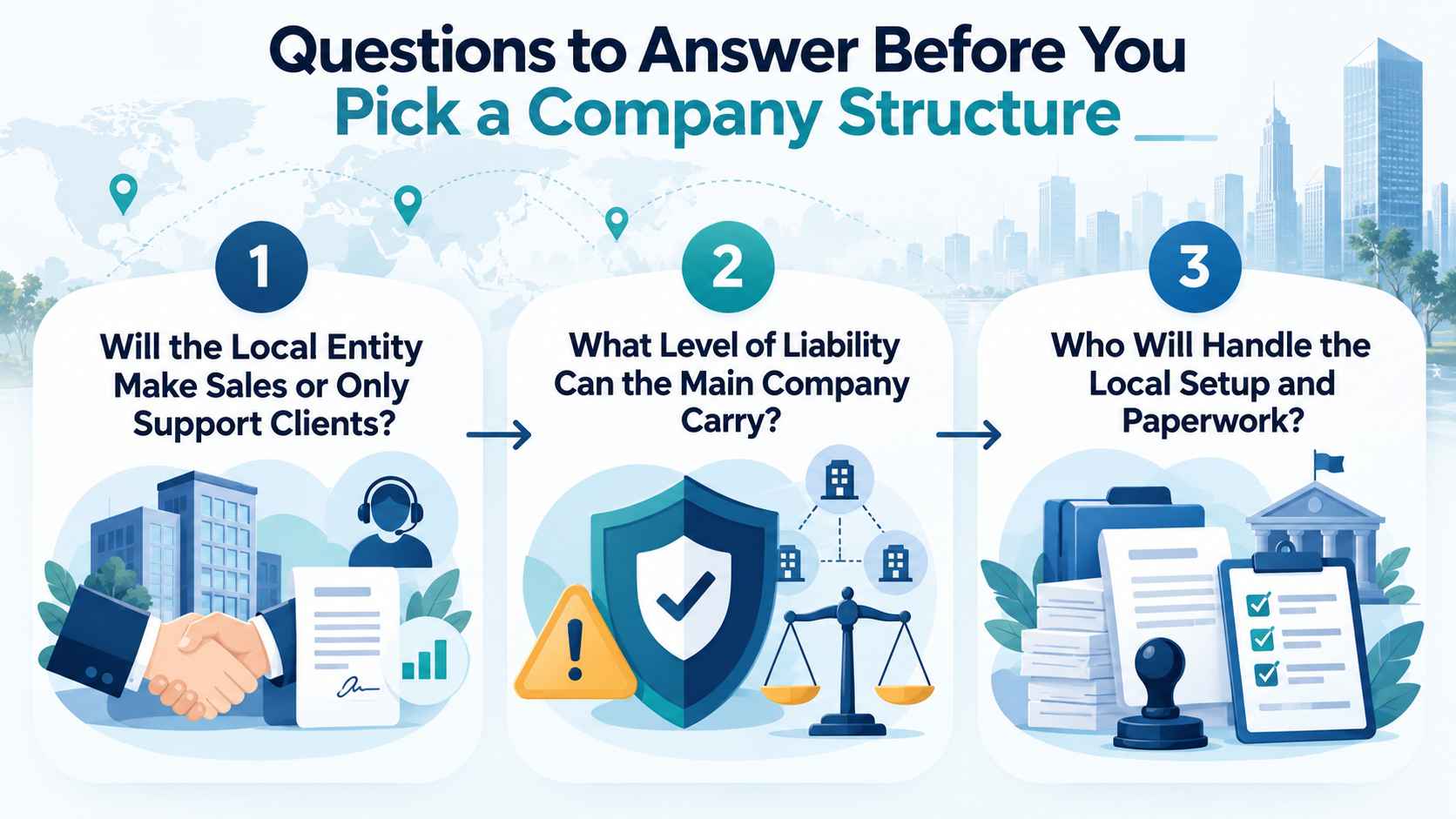
The right structure depends on what you plan to do in the new market. Local sales, existing clients and legal risk can all affect the choice. Local registration rules also matter, especially in countries with strict limits on foreign branches.
Before you choose a branch, subsidiary or another structure, look at the factors below.
Selling Locally or Supporting Existing Clients
If you plan to sign local contracts, issue invoices and collect payments, a subsidiary is often the better choice. Some countries also limit branch activity. India, for example, requires prior central bank approval for branch offices.
A branch can work well if the parent company keeps billing and the local team only handles support or account management.
How Much Risk Your Parent Company Can Absorb
A branch can expose the parent company to local debts and legal claims. If one dispute abroad could create serious financial pressure, a separate local entity may offer better protection.
Getting Local Help With Registration
Foreign company setup can involve banks, tax offices, notaries and local registration rules. In Montenegro, Vega Plus can handle company formation, bank accounts, residence permits and accounting.
Foreigners can fully own a Montenegrin company. Corporate income tax starts at 9% for profits up to €100,000, and DOO registration can often be completed within about seven working days.
Legal Structure of a Branch: Fast Entry, No Shield

A branch isn’t a separate company. Legally, it’s your company operating at another address. That means the parent is directly responsible for the branch’s debts, contracts and legal obligations. In return, you get simpler governance and consolidated financial reporting.
Don’t expect to open one overnight, though. As Samuel Pollack and Naoko Watanabe of the law firm Baker McKenzie point out, the belief that branches are easier to set up is a common misconception, since the process can be just as demanding as forming a subsidiary and may require extensive disclosure about the parent.
Tax is the other trap. According to IRS documentation, a foreign corporation operating through a US branch faces an additional 30% branch profits tax, although a tax treaty can reduce that rate.
When a Branch Is the Smart Choice
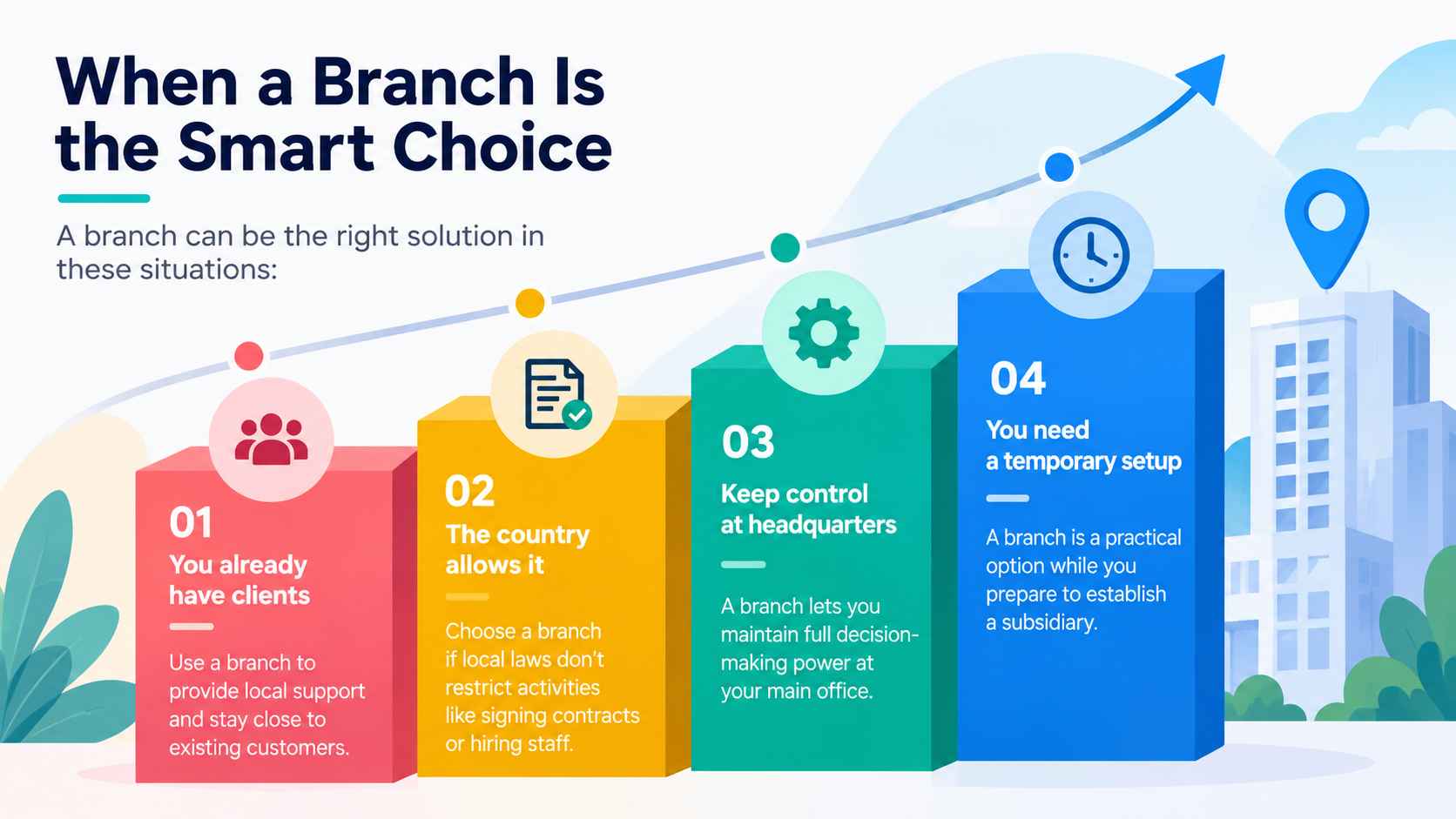
A branch works well in a handful of clear situations:
- You already have clients in the country and need local support rather than new sales.
- The target country doesn’t restrict branch activities such as signing contracts or hiring staff.
- You want every important decision to stay at headquarters.
- You need a temporary presence while a subsidiary is still being formed.
Legal Structure of a Subsidiary: Built for Long-Term Growth
A subsidiary is a separate legal entity incorporated under local law. The parent company owns the shares but generally isn’t liable for the subsidiary’s obligations, unless it signed a guarantee or effectively ran both companies as one.
What You Gain and What You Pay
The advantages are concrete. Your risk is limited to what you invested, local incentives become available because the state treats you as a domestic company, and customers see you as a committed player in the market.
The price is more administration. Registration takes longer, governance and reporting are separate, and profits may be taxed locally and then again when you send them to the parent. Share capital is another factor.
Check the rules in your target country first; the German Limited Liability Companies Act, for instance, spells out exactly how much you must commit before registration.
Who Runs the Company on the Ground
Local managers in a subsidiary have more authority and make decisions faster, but employees can drift away from the parent company’s culture over time. That’s why your first local director matters more than it seems. If that person leaves after a year, their contacts and market knowledge leave too, so it pays to think about talent retention for senior leaders before you even make the hire.
Legal Structure of a Holding: When You Plan Beyond One Country

A holding company doesn’t trade on its own. It owns shares in the operating companies below it. Its job is strategic oversight, moving cash between group companies, holding intellectual property and consolidating reporting. When the group needs new funding, investors come in at the holding level, and the local companies stay untouched.
Choosing where to base the holding takes care, because tax treaties and substance requirements vary widely. Beyond the traditional European options, more founders now look at hubs like the UAE, and our overview of Dubai as a global business hub covers why.
Why a Holding Rarely Fits Your First Entity

If you’re opening one company in one country, a holding adds cost and reporting without any real benefit. That changes once you already know your second and third markets. A structure that doesn’t allow for expansion or an eventual exit will need reorganizing later, and that can get expensive.
FAQ
Conclusion
There’s no universally best legal structure, only the one that fits what you’ll actually do in the new market. A branch suits supporting existing clients, a subsidiary suits serious local sales and protects the parent, and a holding makes sense once expansion stops being about a single country.
Write down what you plan to do over the next two to three years, check the rules of your target country, and only then sign the first document.