
The right growth strategy addresses your company’s main constraint with the least irreversible risk. A business with strong demand but limited delivery capacity needs operational scaling.
A company with spare capacity and weak sales should improve market penetration or distribution before launching another product. A mature firm dependent on one major customer may need a new segment, geography, or channel.
Careful selection matters because growth expectations have weakened while digital investment is accelerating. The Federal Reserve’s 2026 employer firms report found that reaching customers and growing sales was the most common operational challenge.
Its revenue expectations index fell from 39 to 33, the lowest level since the 2020 survey. Direction should come from customer evidence, unit economics, execution capacity, cash exposure, and a defined test.
Start With the Growth Constraint
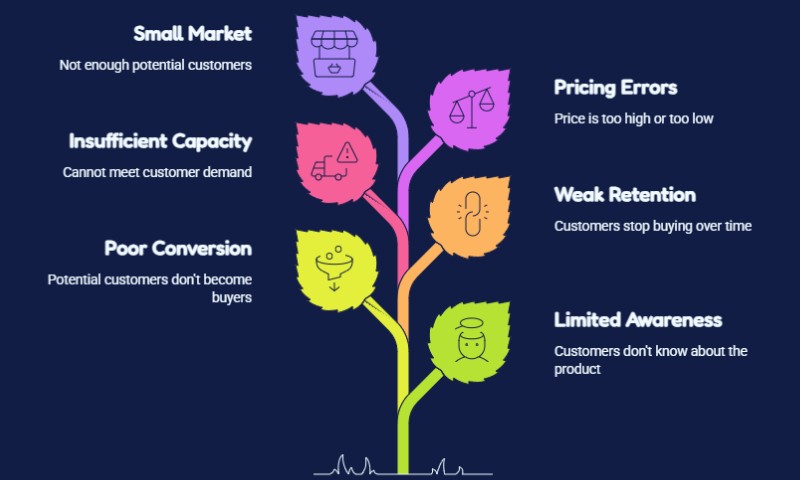
Choose a strategy only after identifying what prevents revenue from increasing profitably.
Low sales can result from limited awareness, poor conversion, weak retention, insufficient capacity, pricing errors, or a market that is too small. Marketing will not solve a fulfilment bottleneck. A new product will rarely repair high churn. Expansion into another country can magnify a weak operating model.
The U.S. Small Business Administration recommends assessing demand, market size, saturation, pricing, customer location, and barriers to entry through market and competitor research. Internal data should sit beside that external research.
Track revenue and gross profit by segment, contribution margin, acquisition cost, retention, capacity utilisation, and cash runway. A strategy becomes credible when the numbers show an opportunity and the company’s ability to pursue it.
Compare the Main Growth Paths
Most growth plans fit into one of five practical directions. Each option requires a different level of investment, evidence, and organisational change.
| Growth Direction | Best Fit | Early Evidence | Main Risk |
| Market penetration | Strong offer, low share in an existing market | Better conversion and repeat sales | Marketing spend without durable retention |
| Product development | Loyal customers requesting adjacent solutions | Pre-orders and paid pilots | Building an offer customers will not buy |
| Market expansion | Proven offer with room in a new segment or location | Local demand and channel access | Regulatory or logistical mismatch |
| Partnerships or acquisitions | Faster access to customers or capability | Shared economics and an integration plan | Dependence, overpayment, or poor integration |
| Operational scaling | Demand exceeds current capacity | Backlogs and long lead times | Fixed costs added too early |
Market penetration is often the least disruptive path because it sells an established offer to a known audience. Product development and geographic expansion require more assumptions. Acquisitions can move faster, but financing and integration risk rise.
Companies pursuing this route may use Buy Side Advisory to assess potential targets, structure the transaction, and prepare for post-deal integration
Long-term survival data support a measured approach. According to the Bureau of Labor Statistics, 34.7% of private-sector establishments created in March 2013 were still operating ten years later, with wide differences by industry.
What Evidence Should Drive the Choice?

The strongest direction has visible demand, sound economics, realistic operating fit, and a test that can produce an early signal.
Customer behaviour should carry more weight than opinions. A paid pilot, deposit, renewal, referral, or repeated purchase is stronger evidence than praise in an interview. Lost sales and support requests can also expose unmet needs.
Revenue growth can weaken a company when discounts, fulfilment costs, returns, support hours, or financing expenses rise faster than sales. Contribution margin should remain positive after costs created by the plan.
Execution fit matters as well. A retailer may have strong traffic but need better inventory data before adding marketplaces. A consultancy may see demand abroad but lack managers who can protect service quality.
Where evidence remains limited, favour reversible moves. A 12-week channel pilot offers more control than a long lease, major hiring programme, or full product launch.
Why AI Is Leverage, Not a Growth Direction
Artificial intelligence can improve execution, but adopting AI does not determine which market, customer, or offer a company should pursue.
Data published by the U.S. Census Bureau for December 2025 through May 2026 showed overall business AI use between 17% and 20%. Adoption reached 37% among firms with at least 250 employees, while fewer than 20% of firms with four or fewer employees reported use.
An OECD survey of more than 5,000 small and medium-sized enterprises found generative AI in use at 31% of surveyed companies. Among users, 65% reported improved employee performance, while 26% reported increased revenue, according to the OECD generative AI study. Technology should therefore be tied to a defined commercial problem.
For a sales bottleneck, AI may help qualify leads. For constrained capacity, it may reduce administrative work. For weak retention, it may flag account risk earlier.
Digital readiness also varies. In its 2026 digitalisation report, Eurostat stated that 71% of EU small and medium-sized enterprises reached at least a basic level of digital intensity in 2025, compared with 96% of large businesses. Firms with fragmented data may gain more from basic systems than advanced software.
Use a Simple Scoring Model
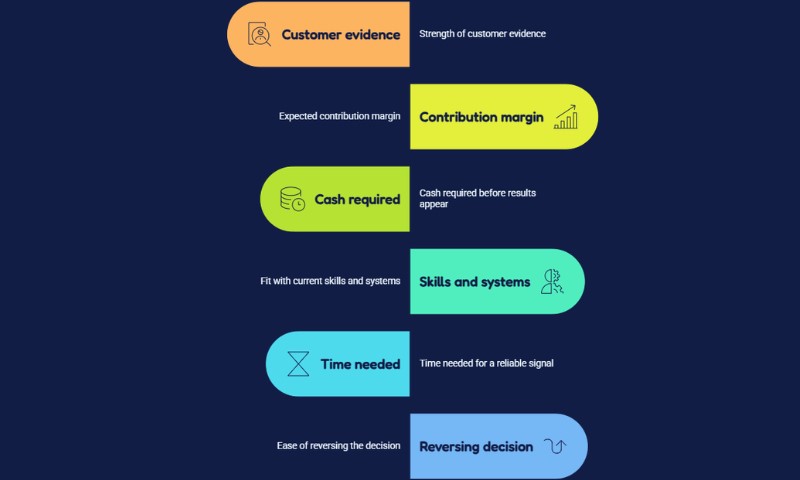
Score each option from one to five across six factors:
- Strength of customer evidence
- Expected contribution margin
- Cash required before results appear
- Fit with current skills and systems
- Time needed for a reliable signal
- Ease of reversing the decision
Weight demand and economics more heavily than excitement or headline market size. Reject any option that threatens cash runway under a conservative scenario. A smaller opportunity with faster feedback can be preferable to a glamorous plan that consumes capital before demand is proven.
Run a 90-Day Growth Experiment
A growth strategy should begin as a measurable hypothesis, rather than a permanent commitment.
During days 1 to 15, define the target customer, offer, channel, baseline metric, spending limit, and stopping rule. During days 16 to 45, run a narrow pilot with real customers. Days 46 to 75 should test repeatability without founder involvement or heavy discounts. During the final 15 days, compare results with the original assumptions and decide whether to scale, revise, pause, or stop.
Use one primary success measure. A market penetration test might track contribution profit from new customers. A product pilot might focus on paid conversion and delivery cost. Guardrails can cover churn, service quality, refunds, cash use, or employee workload.
Practical Examples
A hypothetical agency operating at 90% capacity with strong referrals and long delivery times should probably avoid entering another market. Better options include raising prices, standardising intake, hiring selectively, and reducing low-margin work. Delivery capacity is the constraint.
A software company with good retention but weak new-customer growth faces a different problem. Product expansion may distract the team. A sharper customer segment, partner channel, or improved trial onboarding may produce a quicker result. Acquisition is the constraint.
Final Takeaway
Choosing a growth strategy is an allocation decision involving limited capital, attention, talent, and time.
The right direction solves the most important constraint, protects unit economics, fits current capabilities, and creates evidence quickly.
Nowadays, more tools are available for research, automation, and distribution, but tool availability does not replace strategic discipline. Growth becomes safer when leaders test a narrow thesis and expand only after the model proves repeatable.