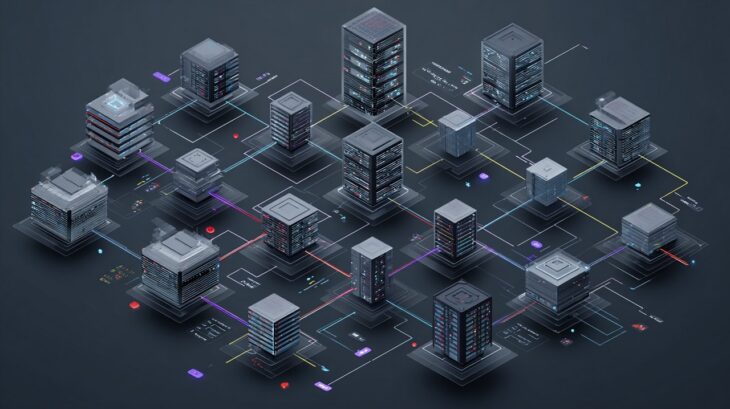
In 2026, technological change accelerates at an unprecedented rate as AI native platforms, sovereign cloud models, and multi-agent systems move into daily business operations.
Competitive advantage increasingly depends on infrastructure that adapts quickly, protects sensitive information, and scales without friction.
Organizations that invest strategically in modern foundations gain measurable improvements in resilience, productivity, and customer satisfaction.
Long-term success depends on aligning infrastructure decisions with operational goals instead of chasing trends.
1. Robust Cybersecurity, AI Enablement, and Threat Detection

Cybersecurity threats accelerate in speed and complexity as attackers rely on automation and artificial intelligence to bypass traditional defenses.
Human response times no longer meet modern attack velocity, forcing organizations to adopt systems capable of autonomous decision-making.
Security platforms powered by machine learning analyze behavior continuously, allowing abnormal patterns to surface immediately instead of after damage occurs.
AI enablement strengthens security posture by enabling predictive defense rather than a reactive response.
Modern threat detection platforms focus on actions instead of signatures. Behavioral analysis identifies credential misuse, lateral movement, and privilege escalation in real time.
Defensive value becomes most apparent through capabilities that operate automatically once risk thresholds are crossed, including:
- Live anomaly detection across endpoints, cloud workloads, and identity systems
- Prompt injection and model manipulation protection targeting AI driven applications
- Automated rollback that restores systems to a secure state without manual intervention
Preemptive endpoint protection now functions as an active control layer instead of a passive monitor.
Malicious activity can be isolated before encryption, data theft, or service disruption occurs.
Managed security solutions allow accounting firms, healthcare organizations, and professional services teams to meet regulatory obligations without maintaining large internal security staffs.
Zero Trust architectures continue widespread adoption as identity replaces perimeter-based security.
Access decisions depend on continuous verification rather than one-time authentication.
Multi-factor authentication, device health checks, and session monitoring work together to reduce exposure. Workforce education remains essential, especially as phishing and social engineering tactics grow more convincing.
Security investment strategies must account for technology, people, and governance together. Reporting, compliance validation, and training require equal prioritization.
Budget models that overlook preparedness increase financial risk, downtime probability, and long-term reputational damage.
2. High Performance and Redundant Network Connectivity

Business continuity depends on reliable connectivity across offices, remote teams, and cloud platforms.
Application performance degrades instantly when latency or packet loss increases.
Symmetrical multi-gigabit fiber connectivity now reaches small and mid-sized organizations, delivering enterprise-level reliability previously limited to large enterprises.
Resilient network design relies on multiple coordinated technologies rather than a single connection.
Organizations reduce downtime risk through architectures that integrate redundancy and intelligent routing.
Effective strategies rely on combinations that include:
- SD WAN platforms that dynamically select optimal traffic paths
- Automated failover across multiple service providers
- Intelligent routing policies aligned with application priority
Zero Trust Network Access continues replacing legacy VPN models by enforcing identity verification and device posture checks before granting access.
Remote work security improves while reducing the attack surface area.
Ongoing network assessments remain necessary. Aging access points, underpowered switches, and outdated firmware introduce hidden performance issues.
Modern networking hardware supports centralized management, real-time telemetry, and integrated security enforcement across distributed environments.
3. Scalable and Secure Cloud Infrastructure

Modern cloud architecture enables growth without sacrificing control or compliance.
Hybrid cloud models allow workloads to move dynamically across private and public environments while maintaining predictable performance.
Sovereign cloud options provide geographic and jurisdictional data control, supporting regulatory mandates tied to data residency and access governance.
Confidential computing strengthens security by encrypting data during active processing rather than limiting protection to storage or transit phases.
Financial services and healthcare organizations rely on this capability to run sensitive analytics without exposing raw data.
Practical results already demonstrate improved compliance alignment while preserving analytical power.
Sovereign cloud adoption increases among nonprofits, government contractors, and regulated enterprises that require domestic data storage alongside collaboration platforms.
Elastic capacity and built-in redundancy support business continuity planning and disaster recovery while enabling remote work at scale.
Cost optimization remains a critical operational discipline. Cloud environments scale quickly, often faster than oversight processes.
Effective governance includes continuous usage analysis, service rightsizing, and contract reviews to prevent unnecessary spend and security gaps.
4. Future Proof Hardware and Edge Devices
Physical infrastructure maintains critical importance despite widespread cloud adoption.
Distributed teams and latency-sensitive workloads depend on reliable local performance.
Modular server designs support flexible deployment across hybrid environments while simplifying maintenance and upgrades over time.
Storage architectures combine solid-state performance with scalable network-attached and storage area systems to support synchronization across locations.
Networking equipment increasingly includes remote diagnostics and configuration, reducing operational overhead and on-site intervention requirements.
Energy efficiency influences hardware selection as sustainability goals align with cost reduction. Power-efficient devices reduce operational expense while supporting environmental targets.
Structured lifecycle management improves stability and security, with three to five-year refresh planning reducing failure risk.
Edge computing adoption expands rapidly within logistics and manufacturing. Smart devices and AI-driven robotics perform real-time analysis directly at operational sites, improving accuracy, reducing labor dependency, and enabling faster decision cycles.
5. Integrated Data Management and Storage Solutions
Data functions as a strategic asset and compliance obligation in 2026. Disconnected or inaccessible information increases risk and limits operational agility.
Hybrid storage models balance speed, cost control, and security by distributing workloads across on-premises systems and cloud services.
Compliance-driven architecture supports healthcare, financial reporting, and regional privacy regulations.
Redundant cloud backups and tested disaster recovery workflows protect organizations against ransomware, accidental deletion, and infrastructure failure.
Digital provenance solutions gain traction as intellectual property protection grows more complex. Authentication and traceability reduce misuse while strengthening trust in digital assets.
Reliability depends on validation processes rather than assumptions, which is why continuity strategies emphasize:
- Automated backup verification and scheduled recovery testing
- Geo redundant storage aligned with regulatory requirements
- Continuous monitoring tied to retention and access policies
Data governance evolves alongside infrastructure. Role-based access, retention enforcement, and audit trails protect operational integrity while simplifying compliance reporting.
6. Intelligent Automation and AI-Driven Operations

Operational structures shift in 2026 as artificial intelligence collaborates directly with human teams instead of functioning solely as a background tool. Workflows become adaptive, responding dynamically to demand changes and operational signals.
Multi-agent platforms coordinate logistics, customer service, and inventory with minimal supervision.
Regional logistics providers already deploy autonomous agents that optimize routing, reduce delays, and improve fulfillment accuracy.
No code and natural language development platforms shorten application delivery timelines significantly.
Business units deploy internal tools without extended development cycles or heavy engineering dependency.
Domain-specific language models increase accuracy within specialized workflows, particularly in legal review, healthcare analysis, and financial forecasting.
Professional services organizations report substantial efficiency improvements through AI-assisted contract analysis, cutting review timelines by more than half.
Physical AI integrated into robotics and IoT systems transforms warehouse and manufacturing operations through continuous sensing and localized decision-making.
Operational leadership benefits most by targeting friction points suited for AI collaboration rather than focusing exclusively on task replacement.
Summary
In 2026, business infrastructure functions as a living system that adapts continuously to operational demands. Strategic alignment between technology investments and organizational goals separates resilient companies from reactive ones.
Strong foundations across cloud, networking, security, hardware, data management, and intelligent automation enable sustained growth and innovation readiness.
Long-term performance depends on selecting technologies that directly support business objectives while remaining adaptable to future change.