
You have finished university, applied for twenty jobs, and received three interviews. Two employers wanted experience you do not have, and the third offered a position that barely uses anything you studied.
Going back to university for a master’s degree might seem like the answer. But another qualification costs money, takes time, and will not automatically get you hired.
Postgraduate study is worth considering when it helps you qualify for a particular profession, move into a new field, or learn specialist skills that employers actually use. A well-chosen course can give you opportunities that your undergraduate degree alone would not provide.
Before applying, you need to know which jobs the qualification could lead to, how much you might earn afterward, and what you would be giving up by spending another year studying.
Start With The Job You Want, Not The Master’s Degree
Searching university websites for interesting master’s degrees is an easy way to spend thousands of pounds on a qualification that does little for your career.
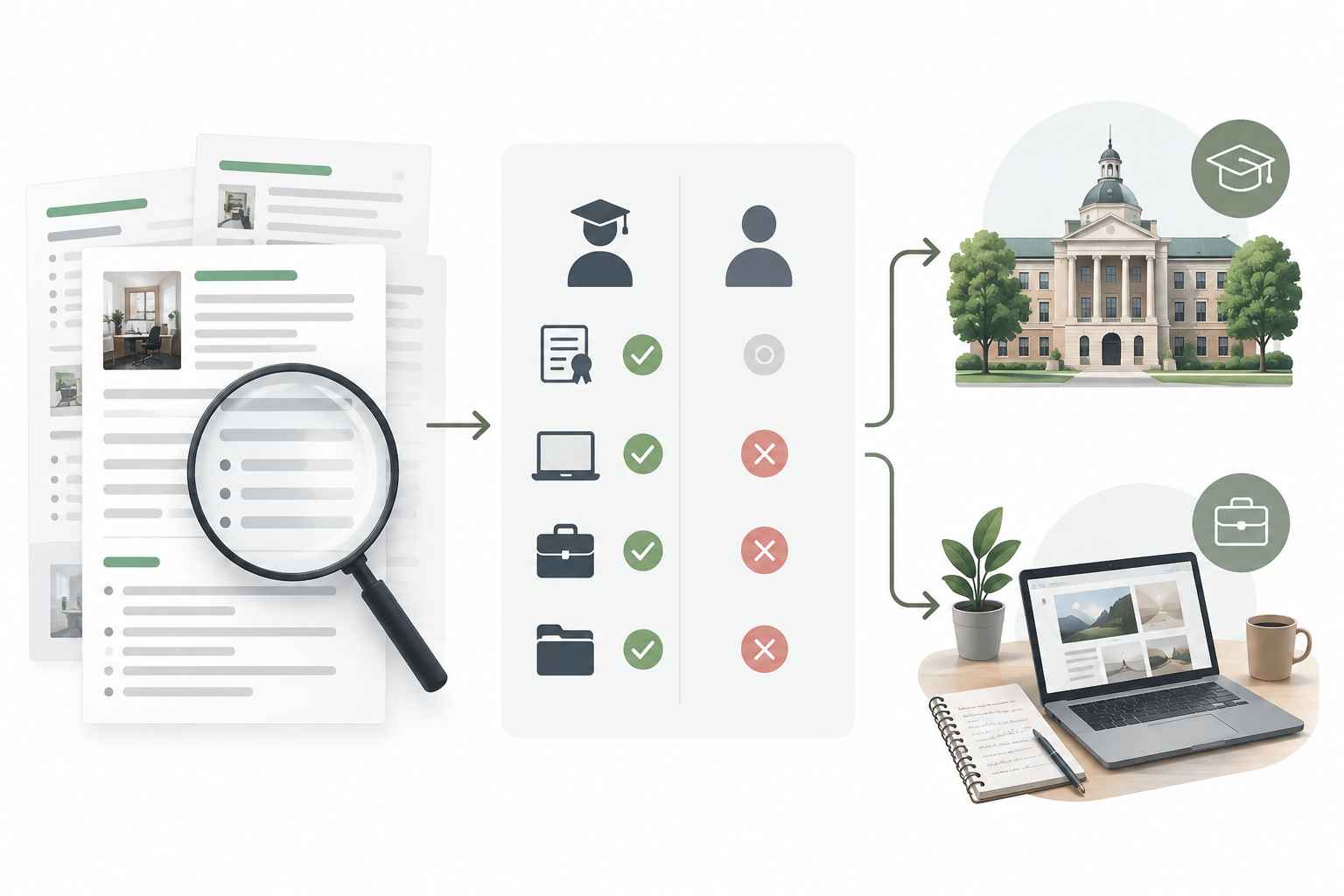
Start by finding five to ten job advertisements for positions you would genuinely like to hold. Read the qualifications and experience employers expect. Pay particular attention to skills that appear repeatedly.
For example, someone interested in becoming a data analyst might find employers asking for SQL, Python, Excel, Power BI, and experience working with datasets.
A master’s degree in data science could help develop those skills. However, if the positions accept applicants with undergraduate degrees and portfolios, a less expensive training route might be enough.
Compare The Job Requirements With What You Already Know
- Missing qualification. The profession requires an approved postgraduate degree or further professional training.
- Missing technical skills. Employers use software, research methods, or specialist equipment you have not learned.
- Missing experience. Employers want previous workplace experience, even though you already meet the educational requirements.
- Missing portfolio. You need completed projects that demonstrate your abilities.
If the main problem is missing experience, another academic qualification may not solve it. An internship, graduate scheme, junior position, or independent project could be more useful.
A Postgraduate Degree Can Help You Change Careers
You do not have to spend your entire career working in the subject you studied as an undergraduate.
A history graduate could move into computing. Someone who studied biology might discover an interest in business analytics. A graduate in English literature could pursue a career in human resources or another field where postgraduate entry routes exist.
Universities offer conversion courses designed for people who want to enter a subject without holding the corresponding undergraduate degree.
According to Prospects’ guide to conversion courses, these programs can last from a few months to several years, depending on the profession and study arrangements.
Career Changes That Postgraduate Study Can Support
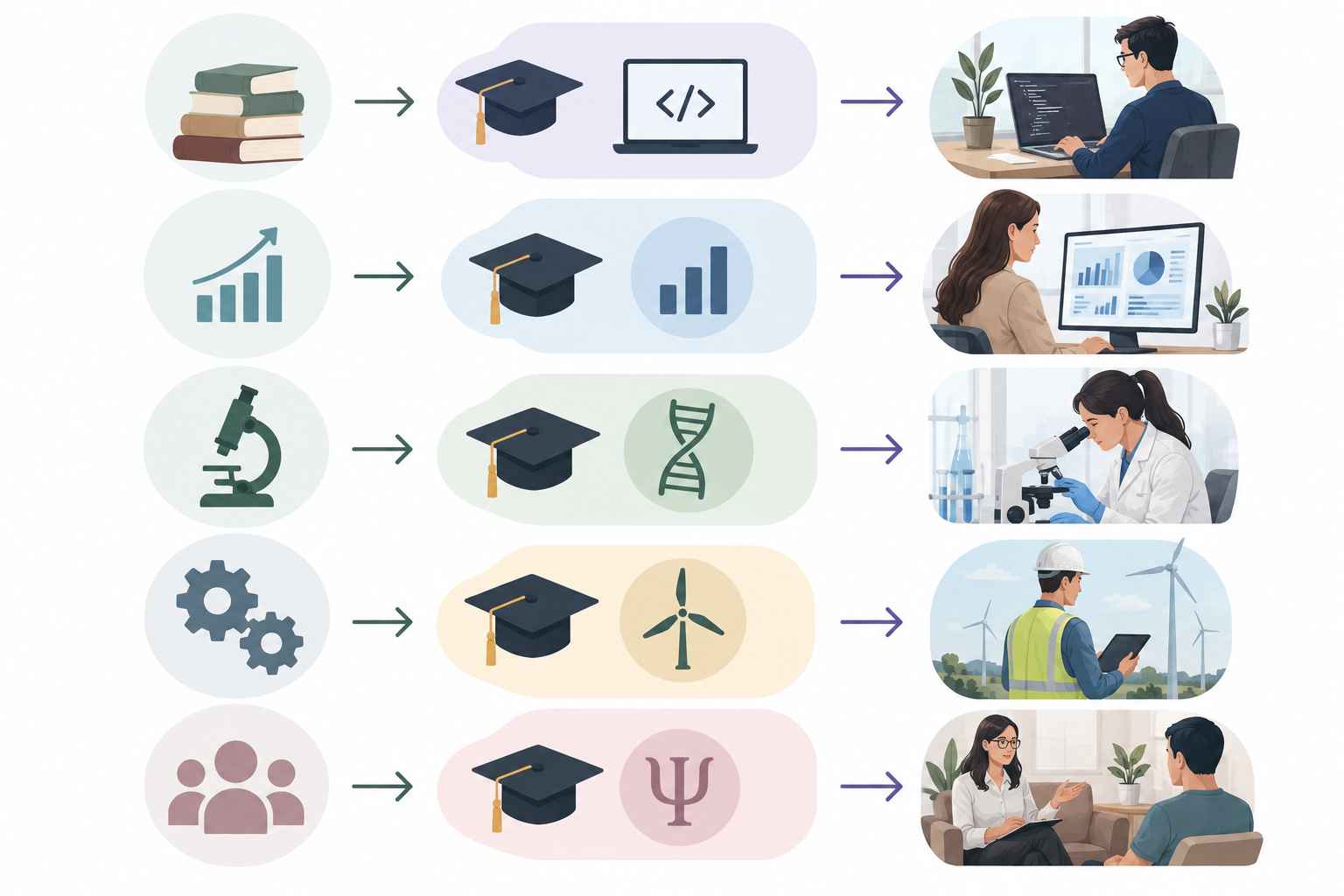
| Undergraduate Background | Possible Postgraduate Route | Career Direction |
| History or English | Computing conversion MSc | Software development or IT roles |
| Business | Business analytics or applied statistics | Data analysis and business intelligence |
| Biology | Bioinformatics | Computational biology and research |
| Engineering | Renewable energy systems | Energy engineering and related technical roles |
| Various undergraduate subjects | Accredited psychology conversion course | Foundation for further professional psychology training |
The table describes possible routes, not automatic entry into the listed occupations. Additional training, professional registration, or work experience may be necessary.
Look For Courses With Real Projects
A computing conversion course that includes programming assignments and a substantial software project gives you work to show potential employers.
A business analytics course with access to real datasets can help you demonstrate how you clean information, perform calculations, and explain findings.
Ask the university for examples of student projects. Also find out which technical tools students use and how much individual work is involved.
The course title alone will tell you very little about the skills you will have when you graduate.
Your Dissertation Can Become Evidence Of Your Skills

A dissertation can give you something useful to discuss in interviews, especially when the research connects directly to your intended profession.
Someone hoping to work in marketing could investigate how pricing affects online buying decisions. A student interested in finance might analyze company performance using published financial reports.
Employers can then ask about the methods you used, the problems you encountered, and how you reached your conclusions.
Choose A Topic That Connects To Your Career
- Marketing. Analyze customer retention, advertising performance, or online buying behavior.
- Finance. Research credit risk, financial reporting, or company valuation.
- Human resources. Study employee turnover, recruitment methods, or workplace training.
- Technology. Build and evaluate software or investigate a security problem.
- Management. Examine supply chain delays, pricing decisions, or operational performance.
Where possible, choose a project that produces something you can explain in a five-minute interview. A clear report, dashboard, working application, or research presentation gives an employer evidence of your abilities.
Managing A Large Research Project
Writing a dissertation involves more than collecting information and putting it into a document. You need to organize your research, explain your findings clearly, and present your conclusions in a way that readers can follow.
Students who want to improve their academic writing can learn from university writing centers, published research papers, and professional dissertation writing services that offer guidance on research structure, academic formatting, and presenting complex information.
Those writing and presentation skills can also be useful after graduation. Business reports, market research, project proposals, and management presentations all benefit from clear explanations, well-organized evidence, and conclusions supported by research.
Being able to turn a large amount of information into a document that colleagues or clients can understand is particularly valuable in careers involving consulting, research, business analysis, and management.
Check How Much Graduates Actually Earn
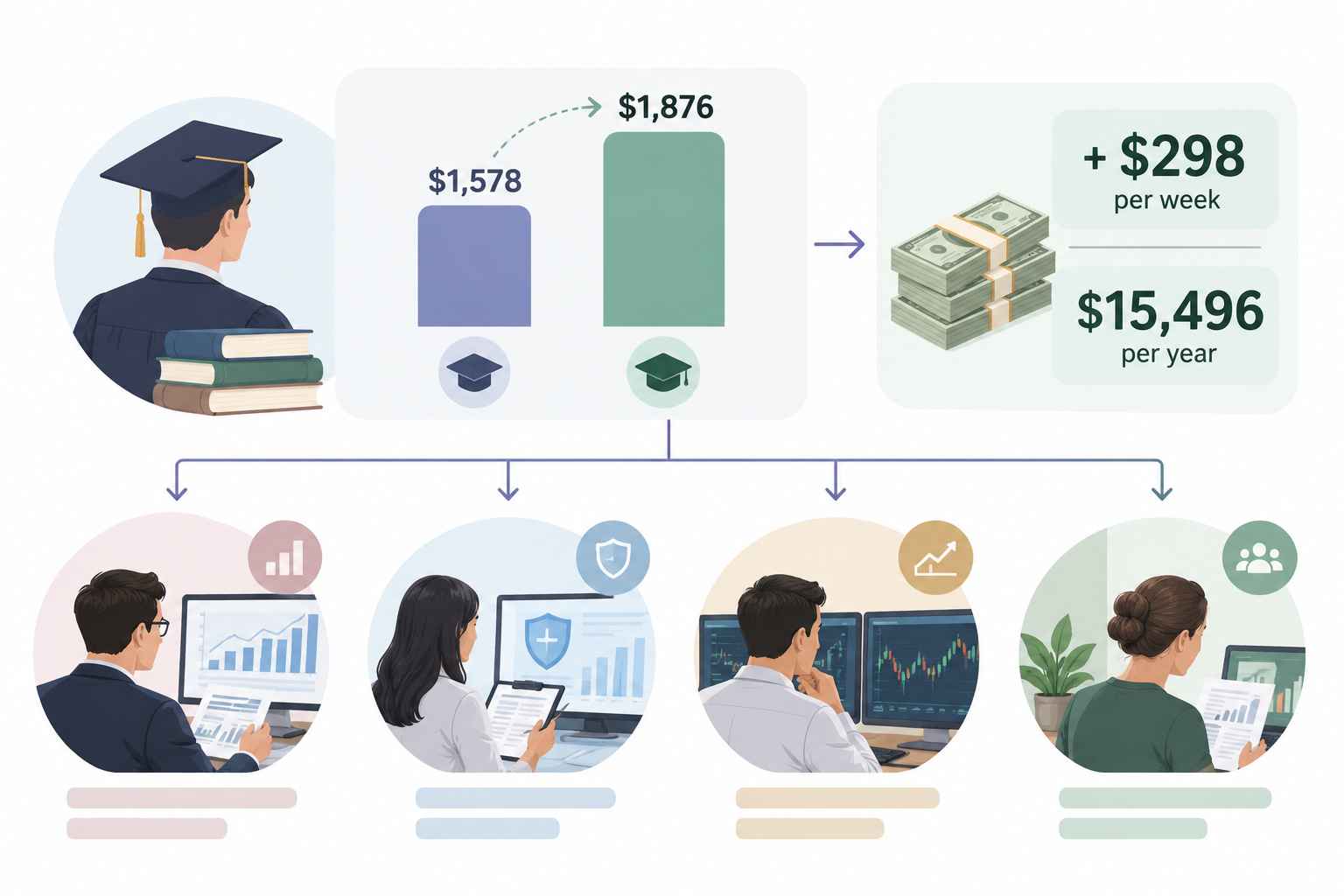
People with master’s degrees earn more on average, but the subject and profession have a major influence on individual salaries.
According to the U.S. Bureau of Labor Statistics, full-time American workers aged 25 and older with a master’s degree had median weekly earnings of $1,876 in 2025. Workers whose highest qualification was a bachelor’s degree earned $1,578.
That is a weekly gap of $298, equivalent to $15,496 over 52 weeks.
The statistics cover workers across many occupations and experience levels. They do not mean an individual graduate will receive a $15,496 raise after finishing a master’s degree.
Compare Salaries For The Actual Jobs
Suppose you are considering a master’s degree in finance. Instead of comparing the average salaries of all bachelor’s and master’s graduates, research these positions.
- Graduate financial analyst
- Risk analyst
- Investment analyst
- Financial planning analyst
Find salary ranges for entry-level applicants in the country or city where you intend to work. Check which positions require postgraduate education and which accept a bachelor’s degree.
Repeat the search for people with three to five years of experience. A qualification that helps you enter a specialist profession may have more long-term value than one that merely adds another line to your CV.
Calculate The Real Cost Before Enrolling
University tuition is only part of the cost of postgraduate study. You may also need to pay rent, transportation, study materials, and ordinary household expenses.
Full-time students who leave employment also give up income they could have earned during that period.

An Example Of A One-Year Master’s Degree
Imagine you have been offered a job paying £28,000 a year, but you are also considering a full-time master’s course costing £12,000.
| Expense Or Opportunity Cost | Amount |
| Tuition fees | £12,000 |
| Additional study-related expenses | £2,000 |
| Gross salary forgone during study | £28,000 |
| Total illustrative cost and forgone earnings | £42,000 |
The example assumes that you could have secured the job, that you would not work during the course, and that your extra study-related spending would be £2,000. Forgone salary is not money paid to the university, and the comparison excludes taxes and living expenses shared by both routes.
Now suppose the qualification helps you secure a job paying £35,000 rather than £28,000. The £7,000 annual gross salary gap would take six years to equal £42,000, ignoring taxes, salary progression, financing costs, and the timing of earnings.
Compare realistic career paths rather than assuming both salaries remain unchanged for six years.
Check Your Funding Options
Eligible students in England starting a master’s course on or after August 1, 2026, can borrow up to £13,206 through the Postgraduate Master’s Loan.
The loan can contribute toward tuition and living expenses, but it may not cover the full cost. Funding rules are separate for students normally resident in Scotland, Wales, and Northern Ireland.
Also ask universities about scholarships, bursaries, funded research places, and employer sponsorship. A part-time course supported by your employer could leave you in a much better financial position than resigning to study full time.
Look For Work Experience Built Into The Course

An employer who wants evidence of workplace skills may be more interested in your completed projects than your final dissertation grade.
Before applying, find out if the university offers internships, industry assignments, consulting projects, or other opportunities to work with organizations.
Four Questions To Ask The Admissions Team
- Which companies have hosted students from this course during the past two years?
- Are placements guaranteed, competitive, or arranged independently by students?
- Can students work on projects involving real business data or clients?
- Which employers have recruited graduates from the course?
Ask for specific examples. A university advertising industry connections may offer guest lectures rather than actual work placements.
If placement opportunities are limited, find out how much freedom you have to choose a dissertation topic involving an external organization.
Part-Time Study Can Be Better Than Leaving Your Job
You do not necessarily need to resign to complete a postgraduate qualification. Universities offer part-time degrees, distance-learning courses, and postgraduate certificates.
For someone already working in marketing, a part-time analytics course could provide new skills without interrupting professional experience.
Similarly, an employee working in operations might study project management and begin applying course material at work.
Choose A Study Format That Fits Your Schedule
- Full-time master’s. Suitable for career changers who need concentrated training and can afford a period away from employment.
- Part-time master’s. Suitable for people who want to develop expertise without leaving work.
- Online master’s. Useful when the university offers suitable teaching, supervision, and assessment remotely.
- Postgraduate certificate. Worth considering when a shorter qualification covers the specific knowledge you need.
Read the assessment timetable before enrolling. A course described as part time may still involve intensive project deadlines and substantial weekly reading.
University rankings can help you identify institutions, but they are a poor substitute for examining the actual course.
A highly ranked university may offer a program with little connection to the job you want. A less famous institution might have stronger industry relationships in your chosen field.
Check These Details Before Applying
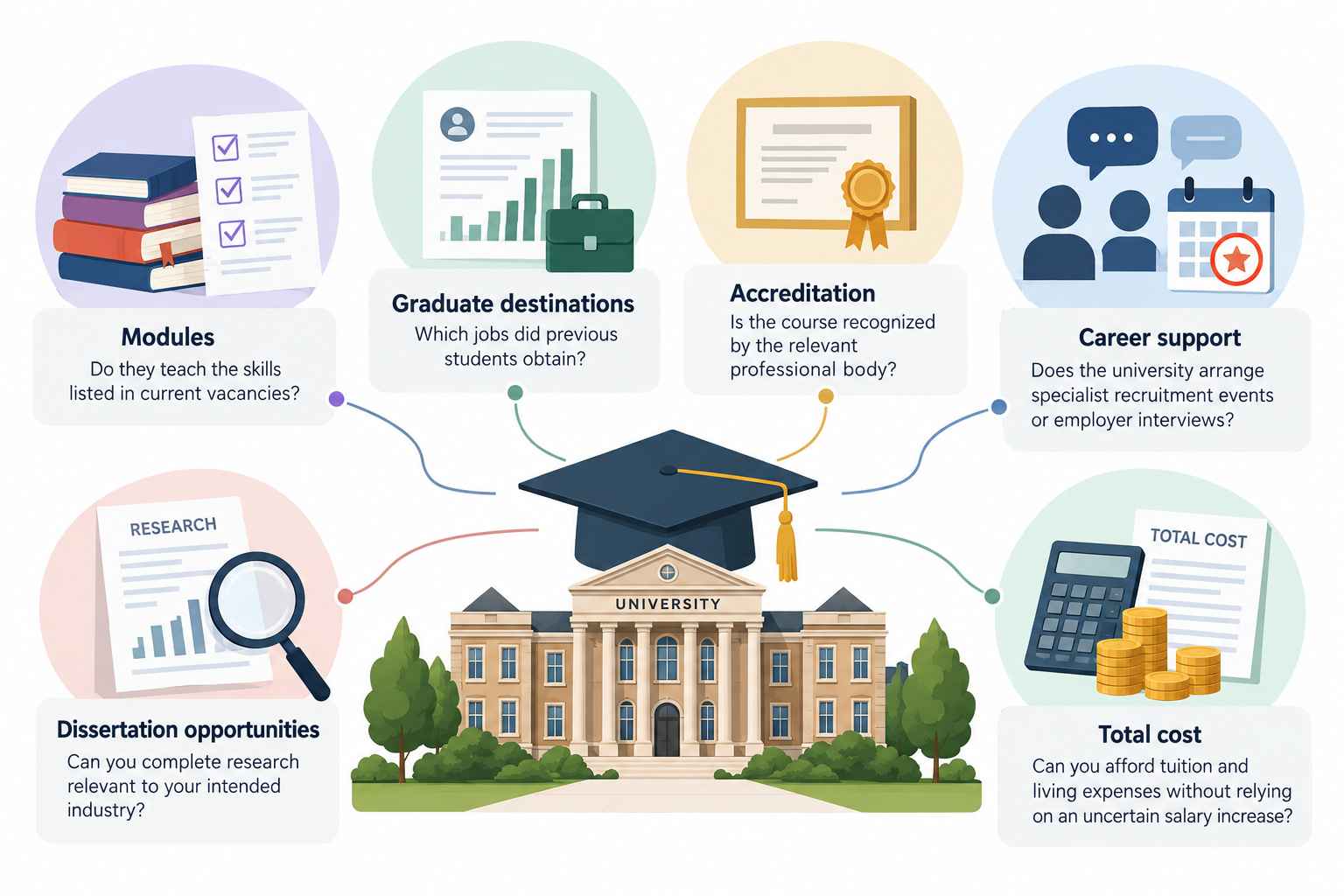
- Modules. Do they teach the skills listed in current vacancies?
- Graduate destinations. Which jobs did previous students obtain?
- Accreditation. Is the course recognized by the relevant professional body?
- Career support. Does the university arrange specialist recruitment events or employer interviews?
- Dissertation opportunities. Can you complete research relevant to your intended industry?
- Total cost. Can you afford tuition and living expenses without relying on an uncertain salary increase?
Speak To Recent Graduates
Contact former students through university events or professional networking platforms. Ask which parts of the course helped them at work and which qualifications their employers considered important.
Someone who completed the program two years ago can tell you more about its usefulness in recruitment than a promotional brochure.
Ask how long their job search took after graduating. A course may provide excellent academic teaching but limited access to employers.
Some Careers Are Better Entered Through Work Experience
Another degree is not automatically the right response to a difficult job search.
In fields such as digital marketing, content production, sales, and many software roles, employers may accept applicants who demonstrate relevant skills through employment or completed projects.
For example, a marketing graduate could spend six months learning Google Analytics, running a small advertising campaign, and producing reports based on actual performance data.
A programming graduate could build a functioning application, publish the source code, and explain the design decisions during interviews.
Those examples may help candidates qualify for positions that do not require a postgraduate degree.
Other careers have formal educational routes. Research positions, certain specialist healthcare professions, and regulated professional occupations may require additional qualifications.
Read the entry requirements set by employers and professional regulators before choosing between further education and direct employment.
Decide Between Starting A Master’s Now Or Working First
Starting immediately after university can work well when you already know which profession you want and have found an appropriate qualification.
However, a year in employment can reveal which parts of a field you enjoy and which skills you actually need.
Choose postgraduate study when you can connect the course to a specific career opportunity. A degree that provides the right technical knowledge, professional eligibility, or relevant project experience can change the jobs available to you. Without that connection, another year at university may simply postpone the same job search.