
A business sale can look simple from the outside. A buyer names a price, the owner agrees, and ownership changes hands. The real process is much less tidy.
Before a deal closes, the seller has to decide what the company is worth, prepare financial records, approach buyers without damaging the business, negotiate price and payment terms, answer months of due diligence questions and resolve legal and tax issues.
Most of the difficult work happens before the closing documents are signed.
Valuation Comes Before the Asking Price
An owner may have a number in mind after years of building the company, but buyers evaluate a business through its earnings, assets, future cash flow and risk.
The US Small Business Administration lists three common valuation methods. The income approach looks at future earnings and the risk attached to them. The market approach uses recent sales of comparable companies. The asset approach starts with what the company owns and subtracts its liabilities.
Those methods can produce different results because they answer different questions. A manufacturing company with expensive machinery may have substantial asset value. A software company may own relatively little physical property but generate strong recurring cash flow.
The SBA guidance on selling a business also points owners toward valuing intangible assets such as intellectual property, customer information and brand value.
A useful valuation should also account for risks that a buyer will notice immediately. Heavy dependence on one customer, weak margins, unresolved lawsuits, expiring contracts or a founder who personally controls every major client relationship can all reduce what a buyer is prepared to pay.

Clean Financial Records Before Going to Market
Buyers want financial information they can test. Three years of accounts that do not reconcile with tax filings can turn an attractive business into a difficult transaction.
The seller should be able to explain revenue, gross margin, operating expenses, debt, working capital and cash generation without rebuilding the numbers every time a buyer asks a question.
One-time expenses also need an explanation. An owner may argue that a legal bill, relocation cost or unusual equipment purchase should not reduce the earnings used for valuation, but the buyer will want proof that the expense really was exceptional.
Customer concentration deserves the same attention. If one customer generates 35% of annual revenue, that risk belongs in the conversation before a buyer discovers it during due diligence.

The Owner Has to Decide What Is Actually for Sale
A business can be sold through its assets or through ownership of the company itself.
In an asset transaction, the buyer acquires selected assets and rights. Those can include equipment, inventory, contracts, intellectual property, customer relationships and goodwill. The agreement identifies what transfers and what remains with the seller.
An equity sale works differently. The buyer purchases shares or membership interests in the legal entity, and the company continues to own its existing assets and obligations.
Tax treatment can change substantially depending on the structure. The IRS explains that the sale of a business is generally treated as the sale of separate assets for federal tax purposes when a group of business assets is transferred.
For qualifying asset transactions, buyer and seller also have to allocate the purchase price among the assets being sold. That allocation affects the tax consequences for both sides.

The Best Time to Fix Problems Is Before Buyers Find Them
A seller should inspect the company with the same skepticism a buyer will bring later.
Missing contracts, undocumented loans from shareholders, expired licenses, unresolved employment disputes and unclear ownership of software or trademarks can delay a transaction after negotiations are already advanced.
Customer and supplier agreements also deserve close review. Some contracts contain change-of-control clauses or require consent before they can be transferred to a new owner.
Fixing a problem before the sale starts gives the owner choices. Discovering it after a buyer has entered due diligence gives the buyer bargaining power.
Finding a Buyer Is More Controlled Than Posting a Business for Sale
Many companies cannot advertise a sale openly without creating problems.
Employees may worry about layoffs. Customers may reconsider long-term commitments. Competitors may use the uncertainty in sales conversations. Suppliers can become nervous about unpaid invoices.
Sellers therefore tend to release information gradually. A potential buyer may first receive a short anonymous description of the company. More detailed information follows after a confidentiality agreement is signed and the buyer demonstrates serious interest.
The likely buyer pool depends on the business. A competitor may value customer relationships or geographic expansion. A private equity firm may focus on cash flow and future acquisitions. A management team may want to buy the company it already runs.

A Serious Buyer Needs More Than Revenue and Profit
Once a potential buyer has passed the first stage, the seller usually provides a much fuller view of the company.
Financial history is only part of it. Buyers also want to know how the company earns money, which customers generate the most revenue, how long contracts last, where growth comes from and which employees are difficult to replace.
A clear sales document can answer many of those questions before management meetings begin.
Forecasts need particular care. Buyers know the future is uncertain, but they will test the assumptions behind projected sales and profit. Forecasts built on a new contract already signed carry more weight than projections based on an unexplained jump in sales.
Several Buyers Can Produce Very Different Offers
The highest headline price is not automatically the strongest offer.
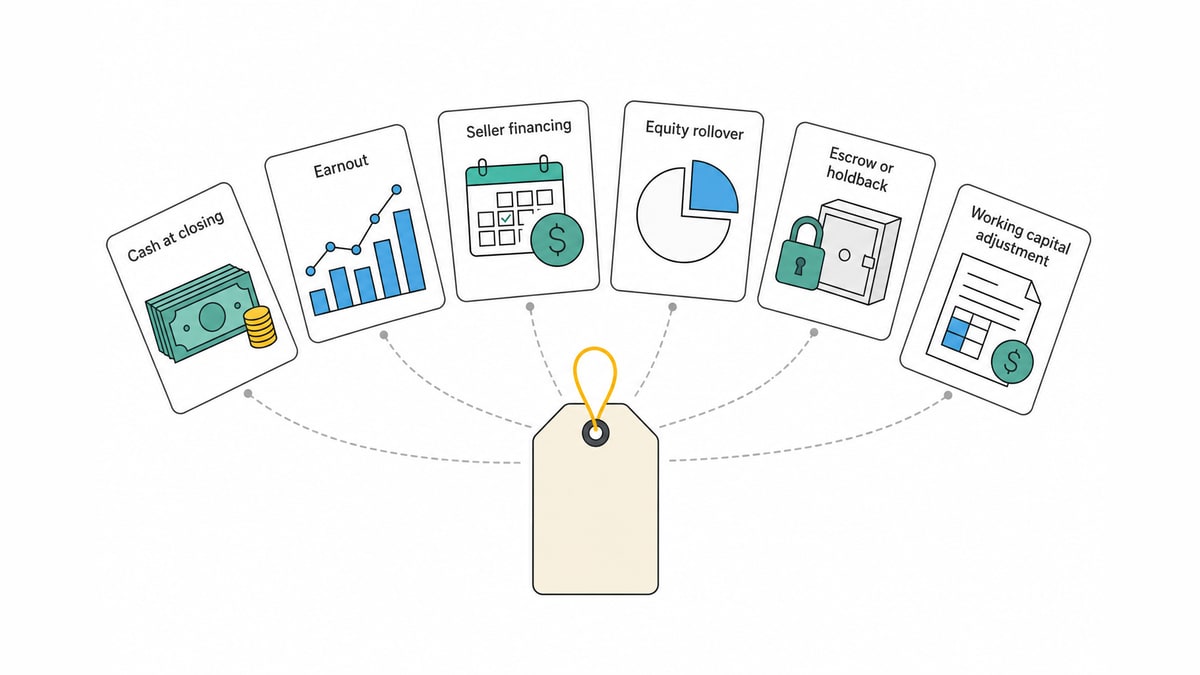
A buyer offering $8 million entirely at closing is making a very different proposal from a buyer offering $8 million with $2 million dependent on future performance.
| Deal Term | What It Changes for the Seller |
| Cash at closing | Money received when the transaction completes |
| Earnout | Part of the price depends on future performance |
| Seller financing | The buyer pays part of the price over time |
| Equity rollover | The seller keeps an ownership stake after the transaction |
| Escrow or holdback | Part of the price remains unavailable for a defined period |
| Working capital adjustment | The final payment changes according to agreed closing accounts |
Financing is another issue. A fully funded buyer presents a different level of execution risk from one that still needs a bank, investor or investment committee to approve the transaction.
The Letter of Intent Narrows the Deal
After a seller selects a preferred buyer, the parties usually record the main commercial terms in a letter of intent.
The document can set out the proposed price, payment structure, transaction form, expected timetable and major conditions. It may also give the buyer a period of exclusivity.
Exclusivity changes the sellers position. During that period, the owner may be restricted from actively negotiating with competing buyers while the chosen buyer investigates the company.
For that reason, the length of the exclusivity period and the buyers ability to complete the transaction deserve careful attention before the letter is signed.
Due Diligence Is Where the Buyer Tests the Business

Due diligence moves the conversation from presentation to verification.
The buyer may examine bank statements, tax returns, payroll records, customer contracts, supplier agreements, leases, debt, intellectual property, insurance, employee records and pending legal disputes.
Financial diligence also tests the quality of earnings. A company may report strong profit, but the buyer still needs to know how much came from recurring operations and how much came from unusual events.
Revenue can receive the same treatment. Buyers may compare invoices, contracts and cash receipts to confirm that reported sales are real and repeatable.
At this stage, more complicated transactions can become difficult for an owner to coordinate alone. Reviewing how professional M&A advisory services handle valuation, buyer selection, due diligence and negotiations gives a useful picture of the work involved in managing a sale from one stage to the next.
A Data Room Prevents the Process From Turning Into Email Chaos
Buyers can ask hundreds of questions during a transaction. Sending individual documents back and forth by email quickly becomes difficult to control.
A secure data room gives the seller one place to organize financial, legal and commercial records. Access can also be restricted so particularly sensitive files are available only to approved people.
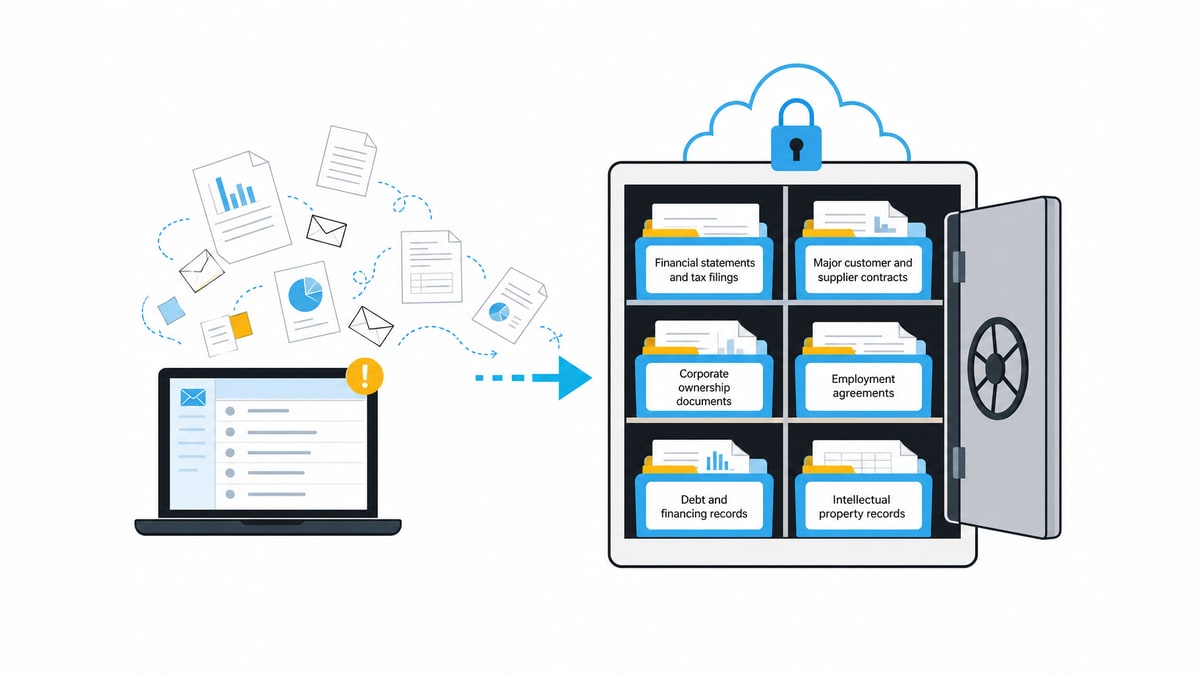
A typical data room may contain several sections.
- Financial statements and tax filings
- Major customer and supplier contracts
- Corporate ownership documents
- Employment agreements
- Debt and financing records
- Insurance policies
- Intellectual property records
- Property and lease documents
- Litigation and regulatory records
Good organization speeds up the review and reduces the chance of different versions of the same document circulating among advisers.
Due Diligence Can Change the Price
The price discussed at the beginning of a sale is not always the price that survives due diligence.
A buyer may discover that a large customer is leaving, an important contract expires soon or reported profit included income that will not continue after the sale.
Problems do not always kill the transaction. The parties can renegotiate price, place money in escrow, change an earnout or add protection to the purchase agreement.
Serious findings can still cause a buyer to leave. The seller then has to decide if the problem can be corrected before approaching the next buyer.
The Purchase Agreement Contains Far More Than the Price

Once due diligence is sufficiently advanced, lawyers turn the commercial deal into a detailed purchase agreement.
The contract identifies what is being sold, how much the buyer will pay and what has to happen before closing. It also contains representations and warranties about the company.
Those statements can cover taxes, financial records, contracts, employees, intellectual property, litigation and many other areas. The agreement also determines what happens if one of those statements later proves inaccurate.
Negotiations can become detailed because the parties are no longer discussing only what the company is worth. They are deciding who carries specific risks after ownership changes.
Purchase Price Allocation Can Have Tax Consequences
In an asset sale, the total transaction price does not simply appear as one tax number.
The IRS requires the consideration in qualifying transactions to be allocated among the business assets. Different categories of assets can receive different tax treatment.
The IRS instructions for Form 8594 explain the allocation system used when a group of assets constituting a trade or business is transferred. Buyer and seller generally report the allocation to the IRS.
Tax review therefore belongs in the negotiation before the purchase agreement is finished. Two offers with the same total value can leave the seller with different after-tax proceeds.
Closing Day Is a Checklist, Not a Single Signature
Closing happens after the conditions in the purchase agreement have been satisfied or waived.
The buyer may need final financing approval. A landlord or customer may need to consent to a transfer. Regulators may need to approve the transaction in industries where ownership changes are controlled.
Money then has to move to the correct accounts. Debt may be repaid. Shares or assets transfer. Directors can resign. Intellectual property assignments, employment agreements and other documents may become effective at the same time.
A deal can therefore be agreed in principle weeks or months before it legally closes.
The Headline Sale Price Is Not the Owners Final Proceeds

A seller who agrees to a $5 million transaction will not necessarily receive $5 million in spendable cash.
Debt can be repaid at closing. Legal, accounting and advisory fees reduce proceeds. Tax follows under the rules that apply to the particular structure.
Earnouts, seller notes and escrow arrangements can push part of the payment months or years into the future.
A realistic proceeds calculation should therefore sit next to the headline offer during negotiations. The figure that counts for the owner is what remains after the obligations connected with the transaction are accounted for.
The Seller May Still Be Working After the Company Is Sold
Some owners leave on closing day. Many do not.
A buyer may want the founder to introduce important customers, transfer supplier relationships or train the incoming management team. The owner can remain as an employee or consultant for an agreed period.
Earnouts create another reason for continued involvement. If part of the price depends on revenue or profit after closing, the agreement needs to state exactly how that figure will be calculated and how much control the former owner retains.
Post-closing working capital adjustments can also remain unresolved for a period after ownership changes.
A Sale Is Usually Prepared Long Before the Business Goes to Market
Owners have far more control when they begin preparing before a buyer appears.
Clean accounts, signed contracts, protected intellectual property and a management team capable of operating without the founder all reduce the number of problems that can surface later.
Valuation then gives the owner a realistic range. Buyer outreach creates competition. Due diligence confirms the claims made about the company, and the final agreement divides the remaining financial and legal risks between buyer and seller.
The process can take months, and larger transactions can take much longer. The work done before the first buyer meeting often decides how much of that time is spent negotiating the deal and how much is spent fixing problems that should have been addressed earlier.