For most independent workers, the hardest part of the job is not the work.
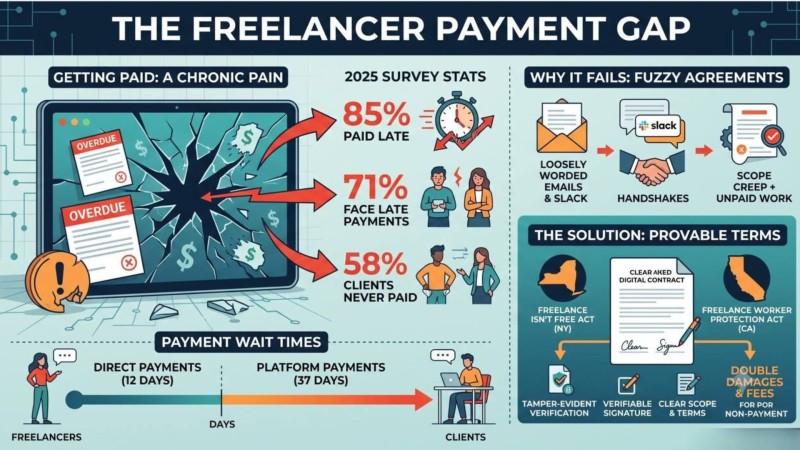
It is getting paid for it. Survey data from 2025 paints a consistent picture: about 85% of freelancers are paid late at least some of the time, 71% have dealt with late payments outright, and 58% have faced a client who simply never paid.
This is not a fringe complaint. It is the baseline condition of freelancing.
The scale of the problem becomes clearer when the main figures are viewed together:
- Around 85% of freelancers experience late payment at least occasionally.
- Approximately 71% have dealt with a clearly overdue invoice.
- About 58% have encountered a client who never paid at all.
The delays are long enough to do real damage.
The average freelancer waits around 39 days from sending an invoice to seeing the money, and the route matters: direct client payments clear in about 12 days, while platform-mediated ones drag out to roughly 37.
The downstream effect lands on the freelancer’s own finances, with 40 to 45% reporting they have missed a personal bill because a client paid late.
When income is this lumpy, a single slow payer can put a solo business underwater for a month.
A Market-Wide Enforcement Problem
Zoom out from any single unpaid invoice and the pattern is structural.
The freelance workforce has grown into a major part of the economy, and Statista projects that around half of US workers will do some freelancing by 2027.
Against that backdrop, industry estimates put the money lost to late and non-payment across the US freelance economy at roughly $15 billion a year, with unpaid freelancers owed about $6,000 each on average.
Those estimates point to two different layers of damage:
- The direct loss suffered by an individual freelancer who is never fully paid.
- The broader economic loss created when millions of disputed or abandoned invoices accumulate across the market.
These are not stories of individual bad luck. They describe a market-wide failure of enforcement that falls hardest on the people least equipped to absorb it.
New Laws Are Raising the Minimum Standard
The law has started to close that gap.
New York’s “Freelance Isn’t Free” Act, expanded statewide on 28 August 2024, requires a written contract for freelance work worth $800 or more.
California’s Freelance Worker Protection Act, in force since 1 January 2025, goes further, mandating a written agreement for services valued at $250 or more and requiring it to spell out the scope of work, the compensation, and the payment terms.
The two laws establish several practical thresholds freelancers should know:
- In New York, the written-contract requirement applies at $800 or more.
- In California, it applies at $250 or more.
- California also requires the agreement to identify the work, the compensation, and the payment deadline.
In two of the largest freelance markets in the country, a written contract is no longer optional.
A Contract Is Only Useful If It Can Be Proven

A written contract, though, is only as strong as a freelancer’s ability to prove it.
That is the difference a freelance contract platform is meant to make: the agreement leaves the conversation with a clear, dated record of what was signed, rather than a PDF buried in an email thread that a client can later claim was never agreed or was somehow different.
The value is not merely that the document exists. The freelancer needs to be able to establish:
- Which version of the agreement was signed.
- When the signing took place.
- What payment amount was accepted.
- When payment became due.
- Whether any later changes were formally approved.
These laws have teeth, which is exactly why provability matters. New York’s statute allows a freelancer who is not paid on time to recover double damages, plus attorney’s fees, and California’s framework carries similar penalties for non-payment and for refusing to provide a written contract.
But a freelancer can only invoke those remedies if they can produce the agreement and show what was owed. A penalty regime is only as useful as the evidence behind the claim, and a forwarded PDF with no verifiable history is the kind of evidence a determined non-payer will simply contest.
California Shows Why Payment Deadlines Matter
California’s rules are specific enough to be worth spelling out.
Under the Freelance Worker Protection Act, an engagement of $250 or more has to be paid by the date set in the contract or within 30 days of the work being finished, and a client who misses that deadline can be made liable for double the amount owed.
The practical sequence is straightforward:
- The contract establishes when payment is due.
- The completion date provides a fallback when no payment date is specified.
- The signed record shows the amount owed.
- The missed deadline creates the basis for a claim.
That doubling is a serious lever, but it exists only for a freelancer who can produce the signed agreement and show when payment fell due. Without provable terms, the strongest remedy on the books stays out of reach.
Scope Creep Becomes Easier to Control
@elvis_w_g Freelancers — Stop Falling for Scope Creep. Protect Yourself. If you’re a freelancer, remote worker, or service provider — listen carefully. Your biggest headache isn’t bad clients. It’s scope creep. 😤 Scope creep is when a client hires you for one thing — then slowly turns you into an unpaid intern for five other things. Here’s how it happens: You’re hired to manage TikTok and Facebook. You agree on strategy, analytics, and weekly reports. Everything’s going smoothly… until week two. Then the client says — “Can you also handle Instagram?” You think, “Ah, it’s just one more platform.” A few days later — “Can you also design flyers for us?” And before you know it, you’re doing five jobs for the price of one. That’s scope creep. And it’s the reason many freelancers burn out, get underpaid, and end up resenting clients they once loved working with. The solution? 👉 Always have a clear contract. Your contract should outline: What services you’re offering What tools you’ll use How long the project will take And what counts as “extra work” that needs new payment If a client requests new work, don’t panic — just renegotiate. Be polite, be professional, but be firm. You’re not rude for setting boundaries. You’re running a business, not a charity. Remember — saying “yes” to everything doesn’t make you valuable. It makes you replaceable. So protect your time. Protect your energy. Protect your rate. 🎯 Join us this Monday for our Web Design Bootcamp — Learn how to build websites, draft professional contracts, and handle clients like a pro. 👉 https://f.mtr.cool/dqteuzasro
The protection is most valuable precisely when a relationship turns. Consider scope creep, the most common quiet dispute in freelancing.
A client who insists “you said you’d also handle the revisions” is much harder to argue with when there is a verifiable record of the original scope and any signed change orders.
Each time the work grows, a quick signed amendment tied to the same record keeps the agreement honest.
That lets the final invoice reflect what was actually agreed rather than what either side now remembers.
A useful amendment should capture the new work, the extra fee, and any revised delivery date. Those three details are usually enough to stop a casual request from becoming a disputed obligation.
Payment Disputes Depend on Evidence
Payment disputes follow the same logic. A freelancer trying to claim a late fee, charge statutory interest, or escalate a non-payment needs to evidence the deal first.
A signed agreement with a verifiable, time-stamped record shows the agreed amount and the agreed deadline in a form that does not depend on the client’s goodwill or on a forwarded email that could have been edited.
Under the new state laws, that same record is also what demonstrates whether the client met, or failed to meet, their legal obligation.
The most useful evidence usually includes:
- The signed contract.
- Any signed amendment or change order.
- The invoice and its issue date.
- Proof of delivery or completion.
- A record of payment reminders and client responses.
The Hidden Cost Is the Invoice Nobody Pursues

The quieter cost is the invoice that never gets fought at all.
A freelancer who cannot readily prove the deal often writes off a disputed payment rather than argue it, because the time and stress of contesting a few thousand dollars outweigh the sum itself.
Multiply that private decision across a year and a whole market, and it is a large part of where that $15 billion goes.
Provable terms change the calculation: when the evidence is a click away, pursuing a late payer is worth the effort, and more often than not the payer settles rather than dispute a record they cannot credibly deny.
Direct Client Work Carries More Exposure
The platform-versus-direct gap is worth dwelling on, because it shows where the risk concentrates.
Freelancers who work directly with clients are paid the fastest but carry the most exposure when something goes wrong, since there is no marketplace holding funds in escrow or arbitrating a dispute.
For direct-billing freelancers, the agreement has to replace several protections that a platform would otherwise provide:
- A defined payment schedule.
- A record of client approval.
- A clear dispute trail.
- Evidence that the work was commissioned.
- Proof that any extra work was separately authorized.
For them especially, the contract is the only backstop.
A verifiable signed agreement gives a direct-billing freelancer something close to the protection a platform offers, without surrendering a cut of every invoice to one.
Cross-Border Work Raises the Stakes

Cross-border work raises the stakes further. A freelancer in one country billing a client in another rarely has a practical way to sue over a few thousand dollars, and the new state laws do not reach a client abroad.
In that situation the agreement is not a route to court so much as leverage in the negotiation that decides whether the invoice is paid at all.
A clear, verifiable record of what was agreed makes a client far less willing to gamble that distance will let them walk away, because the freelancer can document the deal precisely rather than argue it loosely.
Jurisdiction, governing law, currency, transfer fees, and the method of payment are especially important in cross-border contracts because uncertainty around any one of them can delay settlement even when the client intends to pay.
Verification Turns a Contract Into Leverage
The verification piece is what turns a contract from a formality into leverage.
When the signing event is captured as a tamper-evident, time-stamped record, the freelancer can show that this is the exact agreement that was signed, on the date claimed, without asking the client to confirm anything.
The proof belongs to the freelancer, not to the party who owes the money, which inverts the usual power balance in a payment standoff.
That matters because a dispute often turns less on who is morally right than on who can produce the clearest record. A client can deny a conversation. It is much harder to deny a signed, dated agreement with a traceable history.
The Process Does Not Need to Be Heavy
None of this has to be heavy or expensive. Freelancers already work digitally, and signing electronically takes minutes. The shift is simply from a loose file that lives in an inbox to a signed record whose terms can be proven later.
For a one-person business, that shift is the cheapest insurance available against the most common way the job goes wrong.
A Simple Contract Discipline
In practice the discipline is small.
Sign every engagement before the work starts, however informal it feels, and capture the agreement as a record whose terms and date can be shown later rather than a PDF that vanishes into an inbox.
The essential habits are simple:
- Do not begin billable work before the agreement is signed.
- Record every scope change before doing the extra work.
- Tie amendments to the original contract.
- Keep invoices, approvals, and delivery records together.
- Use payment dates that can be objectively verified.
None of this slows the work, and all of it means that when a payment stalls, the freelancer reaches for evidence instead of reconstructing an argument from memory.
Better Contracts Also Improve Client Relationships
There is an upside beyond defence, too.
A freelancer who presents a clear, signed agreement at the start of every engagement signals that they run a real business, and clients tend to treat such a freelancer more seriously on scope and payment from the outset.
The same record that protects against a bad client also sets a professional tone with a good one.
It reduces uncertainty, makes changes easier to price, and gives both sides a shared reference point when expectations shift.
Over time, a reputation for tight, provable agreements is part of what lets a freelancer raise rates and win better work, which makes the discipline an investment rather than only insurance.
Summary
As more states follow New York and California, the written contract will stop being a competitive nicety and become table stakes.
The freelancers who already treat a provable agreement as part of the job, rather than an afterthought, will be the ones least exposed when a client decides not to pay.