Spin-to-win popups look more exciting. Fixed discount popups are simpler. Both can collect email addresses, phone numbers and first-time customers, but recent data shows that the answer is not as simple as saying that a prize wheel always wins.
We looked at current 2026 popup benchmarks from several platforms. One large dataset found that gamified popups generate far more clicks but do not produce a statistically clear increase in completed lead forms. Another platform measured spin-to-win forms at almost twice the signup rate of standard popups.
The difference comes down to how campaigns are built, who sees them and how each platform measures a conversion. Businesses comparing the two formats need to look past click rate and ask a more useful question: which popup produces subscribers who actually use the offer and later buy?
Spin-to-Win Gets More Attention, Fixed Discounts Are Easier to Measure
The strongest argument for spin-to-win is engagement. A visitor has something to do rather than simply reading an offer and deciding whether to enter an email address.
A 2026 Popupsmart benchmark covering 28,674 campaigns found that gamified popups recorded a median click rate of 7.33%, compared with 1.87% for other popups. The wheel itself counts as a click, however, and the same research found no measurable advantage in actual email or phone lead collection.
Wisepops found a different result using its own campaign data. Across campaigns measured from August 2025 through July 2026, gamified formats signed up 10.6% of visitors who saw the form, compared with 4.82% for standard forms. Spin-to-win campaigns alone recorded a 9.3% signup rate.
| Format | Main Strength | Main Risk |
| Spin-to-win | Gets more interaction and gives the offer an element of chance | High click numbers can make performance look stronger than actual lead collection |
| Fixed discount popup | Clear offer and simple signup process | Visitors already exposed to many discount popups may ignore it |
The lesson is not that one study is right and another is wrong. They use different campaign pools, definitions and tracking methods. A business should therefore compare completed signups and later purchases rather than assuming that industry averages will reproduce the same result on its own website.

Promotions Go Far Beyond Website Popups
Companies also use welcome credits, loyalty rewards, rebates, free entries, seasonal offers and member-only promotions to attract new customers or give existing users a reason to return. The same idea appears outside ecommerce.
For example, Peryagame Casino is part of a platform that uses offers such as bonus credits, free entries, rebates and other promotional rewards for new and returning players. The specific incentive changes by campaign, but the marketing principle is similar: the visitor receives an immediate reason to create an account or come back.
A Bigger Click Rate Does Not Automatically Mean More Sign-Ups
Spin-to-win campaigns have an obvious measurement problem. A visitor must click or tap the wheel to interact with it. That means the format naturally creates more clicks than a standard popup, even when the visitor never submits an email address.
For that reason, click-through rate is a weak way to compare the two formats.
The cleaner calculation is:
Completed email or phone signups ÷ popup displays = lead conversion rate
The next step is even more useful. A company can track how many of those subscribers redeem the reward, make a first purchase and return for another order.
Collecting the lead is only the first step, since businesses still need to improve email marketing results if those subscribers are going to become customers.
A wheel that collects 2,000 email addresses but generates 40 orders can be less valuable than a fixed discount that collects 1,200 addresses and generates 90 orders.
Spin-to-Win Works Best When the Brand Can Support the Game

A wheel gives visitors uncertainty before the reward appears. Instead of knowing that everyone gets 10% off, the user might see possible rewards such as 5%, 10%, 15%, free shipping or a free item.
That format fits stores where shopping already includes discovery, impulse buying or seasonal promotions. Fashion, beauty, gifts, accessories and lower-cost consumer products are obvious examples.
It is less convincing when the purchase requires a serious decision. A prize wheel can feel out of place on a B2B software page, legal service website or expensive financial product.
The Prize Mix Changes the Economics
The wheel also gives companies more control over discount cost. A fixed 15% popup gives the same reduction to every qualifying subscriber. A wheel can place smaller rewards on more segments and reserve the largest discount for fewer outcomes.
That can reduce the average incentive cost, but only if visitors still find the available prizes worth giving up their contact information for.
Businesses should also state the offer clearly. If every wheel appears to promise a large prize but almost every user receives the smallest discount, the format loses credibility quickly.
Fixed Discount Popups Remove One Step From the Decision
A fixed popup is straightforward. A visitor sees something such as “Get 10% off your first order,” enters an email address and receives the code.
There is no extra interaction and no uncertainty about the reward.
Recent popup data supports the value of making an offer explicit. Signup popups with a discount code converted at a median 1.46%, compared with 0.75% for signup popups without a discount in the Popupsmart dataset.
The same research did not find evidence that a larger percentage automatically produces more leads. Campaigns advertising 10% off converted at 1.25%, compared with 0.91% for 20% offers and 1.33% for discounts between 25% and 30%. The samples for the larger discounts were smaller, so the numbers do not prove that 10% is universally better.
They do show why increasing the discount should not be the first response to weak signup performance.
The Popup Format Is Only One Part of the Result
Several campaign details can change signup performance more than the difference between a wheel and a standard box.
Keep the Form Short
In the 2026 Popupsmart benchmark, forms with one field converted at 0.88% and forms with two fields at 0.94%. Three-field forms fell to 0.56%.
An email address may be enough for an initial offer. Asking for a full name, phone number, birthday and other information before providing a simple discount adds work before the visitor has developed much trust in the brand.
Show It Where Purchase Intent Is Higher
Placement also changes the result. Popups displayed on cart and checkout pages recorded a 4.57% median conversion rate in the same dataset, compared with 1.07% on homepages and only 0.23% on blog pages.
A visitor comparing products or reviewing a cart has a different reason for responding to a discount than someone who has just opened an informational article.
Do Not Show the Same Popup Forever
Repeated exposure creates fatigue. The first two popup views in a week performed similarly in the benchmark, but conversion declined from the third display.
A visitor who has already closed the same wheel or 10% offer several times is giving the business useful information. Showing it again on every page is unlikely to improve the experience.
Getting the frequency right is just as important as the offer itself, especially if you want to use website popups without annoying visitors.
Mobile Visitors Need a Faster Version
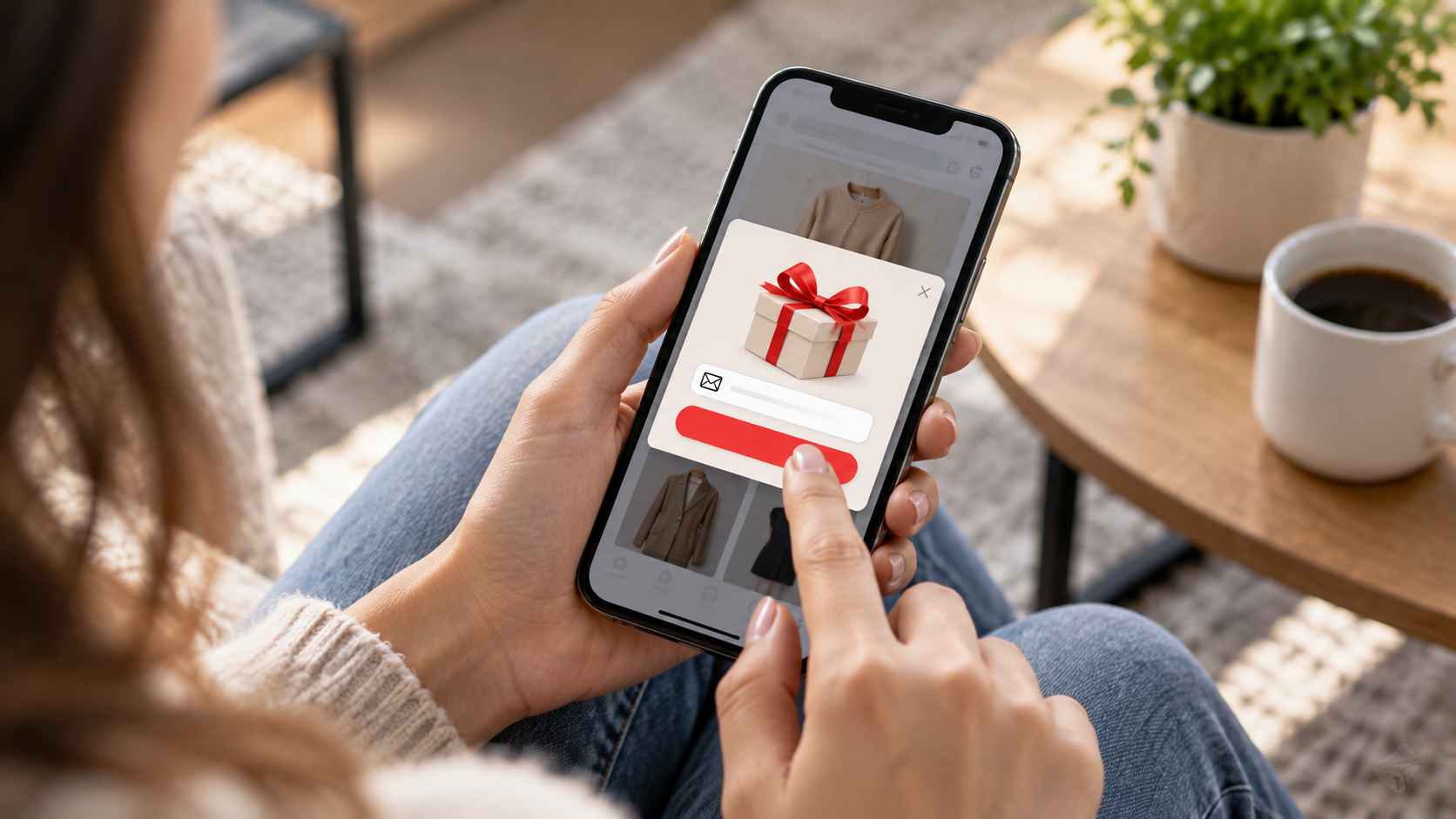
Mobile accounted for 63% of popup displays in Popupsmart’s dataset, and median lead conversion reached 1.02% on mobile compared with 0.57% on desktop.
That does not mean a company should cover a phone screen with a large wheel as soon as the page loads. Small displays leave less room for the product, navigation and close button.
A mobile spin-to-win campaign needs large tap areas and a simple prize layout. A fixed discount needs even less space and can work with one sentence, one email field and one button.
The easier format wins when the game itself makes the signup harder to finish.
Which Popup Should a Business Use in 2026?
| Goal | Format Worth Testing First | Reason |
| Maximum interaction | Spin-to-win | The game gives visitors a reason to stop and participate |
| Simple email capture | Fixed discount | Fewer steps between seeing the offer and submitting the form |
| Seasonal campaign | Spin-to-win | Multiple prizes work well with limited promotions |
| Premium brand | Fixed discount | A simple offer is less likely to clash with a restrained brand presentation |
| Testing discount demand | Fixed discount | It is easier to compare one offer against another |
| Reducing average discount cost | Spin-to-win | Different prize values can be distributed across the wheel |
No universal winner exists across every website. The 2026 data itself shows why. One large dataset found no measurable lead advantage from gamification, while another measured a substantial signup lift.
The safer approach is to test both formats on the same audience.
Run the Test on Revenue, Not Just Email Addresses

A clean A/B test should split similar visitors between a spin-to-win popup and a fixed discount popup. Both versions should appear on the same pages, use the same trigger rules and run during the same period.
The reward value should also stay comparable. Testing a wheel with prizes up to 30% against a fixed 5% offer tells very little about the popup format because the incentive changed at the same time.
- popup displays
- completed signups
- discount or reward redemptions
- orders from new subscribers
- revenue after discounts
Revenue after the promotion is especially useful. A campaign can generate an impressive email list and still lose money if it attracts people who only sign up for a large discount and never return.
The Best Popup Is the One That Brings Back Valuable Customers
Spin-to-win has a real advantage when a company wants participation. Visitors notice it, click it and spend time interacting with it.
A fixed discount has a different advantage. The customer immediately knows what the offer is and what is required to receive it.
Current 2026 benchmark data does not give businesses a reason to declare either format the permanent winner. It gives them a reason to measure more carefully.
Count completed signups instead of spins. Follow those subscribers through reward redemption and purchase. Then compare the revenue left after the discount. That tells a company far more than the number of people who clicked a wheel.